
Experiences, observations and opinions from 40 years of running.
on the subject of…..2021
Just a brief New Years Day look back on 2021 – a game of two halves if ever there was one!
After an optimistic start, looking forward to a reprise of the WealdWay in late March, I fell into a phase of physical and mental struggle with my running by late January. Managing to get myself together just in time to do the WW run, and blessed with unseasonably warm sunny weather, I really enjoyed it – highlight of the year #1.
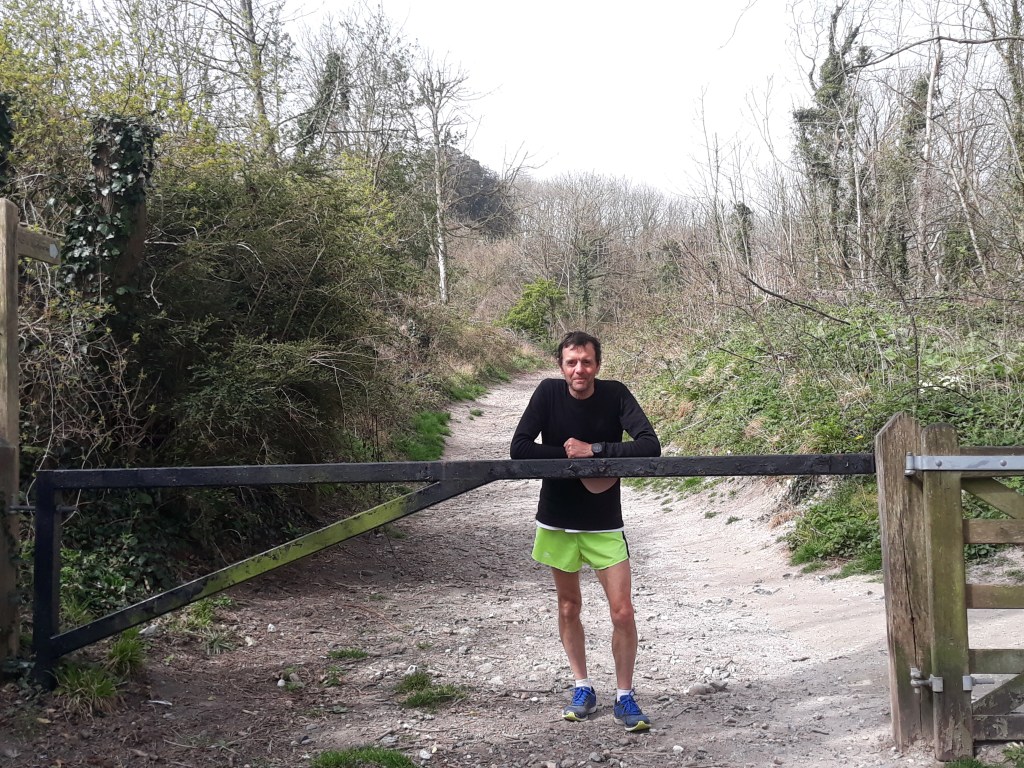
My plan was then to switch to shorter, faster training to aim for some relatively good race times. April training went to plan with some encouraging sessions, but then nosedived inexplicably through May and June when I recorded successive worst ever times for 10K. A general aching and discomfort around the right hip was dragging things down and I felt the need for a break. One last race before easing up went much better than expected, with an age graded 74% 36’32” five miler at Staplehurst on July 11th – highlight of the year #2.
And that’s pretty much where the year ended ! The hip problem meant that running ceased almost completely – a total of 31 miles run from 30th July to 31st December. A recent x-ray found no problem with the hip joint which seems like good news, but no clearer what the problem is. My own bit of self-diagnosis is that the sacroiliac joint may be the source of the discomfort. A few gentle jogs in the past two weeks has at least reacquainted me with my running shoes, so I’ll try to get going again. But other than trying to get fit, I don’t think I’ll be setting too many targets for the new year just yet.
Best wishes for 2022 to you
on the subject of…..clubs
Whilst writing this it has occurred to me that I’ve been very selfish in my relationship with the athletics clubs that I’ve been a member of over the years. I love the existence and structure of the athletics club network in this country, and have been a club member almost continuously for close to forty years. I love putting on club colours and representing my club either as an individual or as part of a team, and yet I’ve rarely played a part in the organisation and behind the scenes activities which are needed to keep an athletic club functioning and flourishing. Sure, I’ve helped marshall races plenty of times, but have never allowed myself to be drawn into the world of organising and committee meetings, or become part of the structural hierarchy of a club. The harsh version of that is that I’m probably not a great team player, but at least it heightens my appreciation of the people without whom our clubs could not function.
The three clubs I’ve been a member of are all geographically very close, but have very distinctly different histories and identities. The three being Tonbridge AC, Tunbridge Wells Harriers and Paddock Wood AC.
I’ve written a few notes previously about my first club – Tonbridge. They are by some margin the longest established of the three, being formed in 1947, and have for many years been a well supported “traditional” athletics club. Sharing the excellent track and field facilities at Tonbridge school, they continue to attract the highest quality athletes from around the region and enjoy success at a national level.
My second club – Tunbridge Wells Harriers was very much borne out of the running boom that resulted from the running of the first London Marathon in 1981. A small group who had trained for that race got together and set up a club – initially under the name Tunbridge Wells Runners. Surviving the early years without their own clubhouse, when I joined we met outside the Cross Keys pub in St Johns, before heading out for a weekly “burn up”. Later sharing use of TW rugby club from 1985, before moving to their current home at the Neville cricket ground in 2006. In 1997 the club membership voted to change it’s name from “runners” to “harriers”, partly perhaps to reflect the strong affiliation the club had developed with cross country running. More recently developing a strong triathlon identity, and without full track and field facilities, it provides a contrast to the strict athletics code at Tonbridge.
I joined my current club – Paddock Wood AC – about 4 years ago, and enjoy competing for them. Formed in the late 1980s by a group of like-minded athletics enthusiasts, many of whom were keen to create a club that their families could become a part of. Many of those founding members are still at the core of the club to this day and have grown a diverse and active membership, still strongly focussed on encouraging and developing young talent, but also competing widely across track and field athletics and distance cross country and road running. The club is based at a still developing track and field facility at Putlands in the town.
Athletics clubs are a microcosm of society, but I would suggest, possessing a higher percentage of good positive people in their ranks, many of whom have become friends and acquaintances down the years. We are lucky to have three such diverse clubs in such a small local area, and I feel proud and privileged to have represented all three at some point over the past forty years. Posted by50000milesontherunPosted inUncategorizedLeave a commenton on the subject of…..clubsEditon the subject of…..clubs
on the subject of…..Dave Bedford
I’ve talked previously about the different ways you can find inspiration in sport and in particular for me, in running. The heroic stories of the greats of the past in the form of biographies and autobiographies make inspirational reading. But one person who for me as a young lad was almost single handed in firing up my early enthusiasm for long distance running, long before I started doing it, was Dave Bedford. Athletics meetings at Crystal Palace were sometimes televised and it was always a great highlight if there was a long distance race that he was running in. If you’re under a certain age, you may not even be too familiar with the name, but he was an exceptional talent and something of a maverick in the late 60s and early 70s, most particularly in cross country running, and 5000 and 10000 metres on the track. His distinctive appearance alone made him memorable, very much a look of the late sixties and early seventies with long flowing hair and a flamboyant “mexican” moustache.
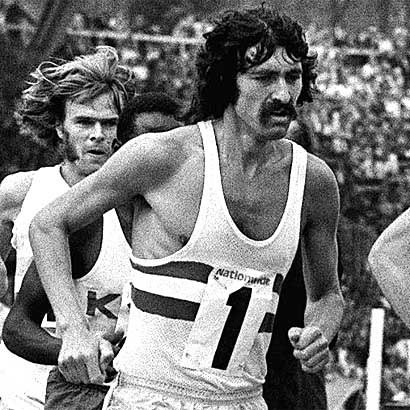
But by combining his exceptional talent with reckless front-running tactics and the capacity to train regularly at up to 200 miles per week, he created an unforgettable persona. Thanks to “youtube”, it’s still easy to enjoy footage of some of his greatest record breaking performances, a couple of which I mention below, and I strongly recommend that you do. His lack of a devastatingly fast finish meant that he achieved little in the way of medals in the great championships, but his bravery at setting out at near suicidal pace at the start of top quality 5000 and 10000 metre track races rewarded him with European and world record times. Witness his European 10000 metre record set during an international match at Portsmouth in 1971, where after enduring a pedestrian 70 second first lap, he leapt into the lead with a dramatic change of pace and a second lap of 59 seconds, leaving the top class field trailing way behind as he churned out lap after lap alone to achieve a time of 27’ 47” – beating the existing record by some 17 seconds. Or his world record 27’ 30” set at Crystal Palace in 1973. It’s generally reckoned that his career ended early due to injuries which were the result of his ferocious training regime – 3 sessions a day, 7 days a week, often amounting to 200 miles a week. He subsequently was well known for his success as race director of the London Marathon for many years. A real athletics legend. To get a full summary of some of his career highlights, read this great article from Athletics Weekly:https://athleticsweekly.com/athletics-news/dave-bedford-top-20-races-1039940411/embed/#?secret=MViPgVPHUq
on the subject of…..the rewards of racing?
I’ve been thinking about how the organising of races, and the expectations of participants and the demands made of race organisers has changed over the years.
In 1982 £1 had the buying power of £3.08 today, and it was pretty normal to pay between 50p and £3 for a race entry in those days – so that would equate to £1.54 – £9.24 in today’s terms. So why is the range now more likely to be anything between £15 – £40 (and in many cases, much more) Thanks to the marvellous club and league set up in this country, it remains possible to race for free as a team member in many events and that’s a wonderful thing. But this isn’t a penny-pinching rant about being reluctant to pay your dues; it’s much more a question about why race organising has become an industry in itself, and if that has become necessary, why has it? It goes without saying that if you’re literally “in the business” of organising races then a reasonable profit needs to be made to keep that business afloat. That just added a few pounds to your entry fee. Have the demands placed by various authorities – regional and national sporting bodies, local authorities, concerns relating to Health & Safety, the police etc etc – become so onerous as to make race organising a minefield that’s best to avoid? Maybe the hoops that have to be jumped through, and the necessary licences obtained to stage an event add another few pounds to the entry fee? Now (as my inner Victor Meldrew takes a hold) to the question of how to suitably reward everyone that completes a race of any distance whatsoever. But maybe the question shouldn’t be how, it should be why? Why does there remain apparent value in being given a chunk of medal on a ribbon to mark the fact that you’ve just jogged 5k in your own sweet time? I realise that within just about every race there’ll be someone for whom just finishing is a genuine and noteworthy achievement, but with a few exceptions the great majority of people lining up for any race of 10 miles or less are reasonably well trained and prepared for it, and maybe shouldn’t be expecting or needing a medal for their efforts ? That medal just added another couple of quid to the entry fee. As the distance involved becomes a more serious challenge I certainly accept that the commitment needed in training to do justice to (for example) a marathon, is deserving of a token of recognition. Even more deserving is a reward for the individuals and teams winning races, who are usually reaping a benefit for the many long weeks, months and years of training at high intensity. It’s a competitive sport, and that’s what competition is all about. If this smacks of “elitism”, don’t forget it’s written by a middle of the pack club runner with no personal axe to grind.
Just that in my view, no real need for a medal every time you run 5k, 5 miles, 10k. And as for a “goody bag” – a polluting plastic bag containing a few unwanted bits of tomorrow’s litter – do me a favour !!!
(Thanks, I feel better for that)Posted by50000milesontherunPosted inUncategorizedLeave a commenton on the subject of…..the rewards of racing?Editon the subject of…..the rewards of racing?
on the subject of…..age grading
With a Marathon PB of 2hr 05’11”, how could Mo Farah run 2hrs 39’ 48” and it be regarded as an improvement ?
Age grading – that’s how!!!
All Sir Mo has to do to regard running a 2hrs 39’48” marathon as an improvement, is to achieve it when he’s 65 years old.
Unless you’ve only recently entered the sport as a veteran and are therefore still on the upward trend that results from exciting new training schedules and maybe a modest starting point, in absolute terms from around the age of forty(ish) you’re going to gradually get slower. If you retain the energy, enthusiasm and physical ability to keep training at an intense level, while you may slow the ageing clock down, there’s no amount of training that can completely hold back the effects of time. Once you’ve come to terms with that fact, there’s great consolation to be found by consulting an age-grading calculator. Based on times compared against the world record, then set on a sliding scale to take age into account, they provide a %percentage figure which you can use to measure how well you are running year-on-year, against your peers, against the youngsters up at the front, but also as a direct comparison from your performances of years ago. For example; if at the age of 30 you could run 10 miles in 56’00”, you would still be running at the same standard – age graded – if by the age of 60 you were able to run it in 68’40”. This helps to show that when the sloping playing field is levelled up, you may not be doing quite as badly as you thought you were. If your “percentages” hold up reasonably well, then relatively speaking, you’re hanging on in there!!! However, you don’t have to be over the hill to get some use out of the grading tools. You can use it to gauge your performances relative to each other even if you’re still a spring chicken. You can also get a steer as to what you might achieve over other distances based on you grade percentage. As another example, a 30 year old running 5 miles in 35 minutes gets a 60.93 % grading. Assuming this to be your expected performance percentage level, the calculator shows that you would run 1hr 35’ 52” for a half marathon.
A quick online search will show you there are plenty of these grading tools available and they are generally fairly comparable, but be aware that they can give some slightly variable results if you are comparing the same result from site to site, so probably best to choose one that suits you and stick with it. Some are a bit more user-friendly than others, and for ease of use a site called www.rat.run/age-grading works pretty well. It’s laid out in such a way, that once you’ve submitted a time for any given distance, it calculates your percentage and then also shows what times you’d need to run to achieve the same level of performance over various different distances. Give it a go – it might put that competitive spring back into your step !!!Posted by50000milesontherunPosted inUncategorizedLeave a commenton on the subject of…..age gradingEditon the subject of…..age grading
WealdWay 2021 – final day
Even though my legs were still screaming from yesterday’s efforts, it felt a lot easier getting out of bed to run again today knowing that it would be the final stretch of the run. Even better that it was just 12 miles to the finish, and with four secluded downland hamlets to pass during the run I was inwardly chanting the mantra “Arlington, Wilmington, Folkington, Jevington” to myself as I drove to today’s start point. Amazingly, the weather continued to behave itself, just a little cooler and breezier than the previous 3 days but still great running conditions. Setting off from yesterday’s finish point in the village of Upper Dicker, the only hint of drama happened within the first mile as I crossed a field containing a very large herd of cattle. After lulling me into a false sense of security by feigning their indifference, they suddenly organised themselves into a full blown stampede, with me clearly fixed in their sights. It’s funny how you find that a change of pace is still possible when you’ve got 50 tons of sirloin steak heading towards you at 20 miles an hour! As you continue south you can’t avoid the sight of the South Downs looming up ahead, and after three or four miles of mainly flat, you reach the tranquil high street of Wilmington and the climbing starts.

Soon passing near the feet of the 235 feet high figure of the Long Man of Wilmington – a chalk carving on Windover hill, that overlooks the village.
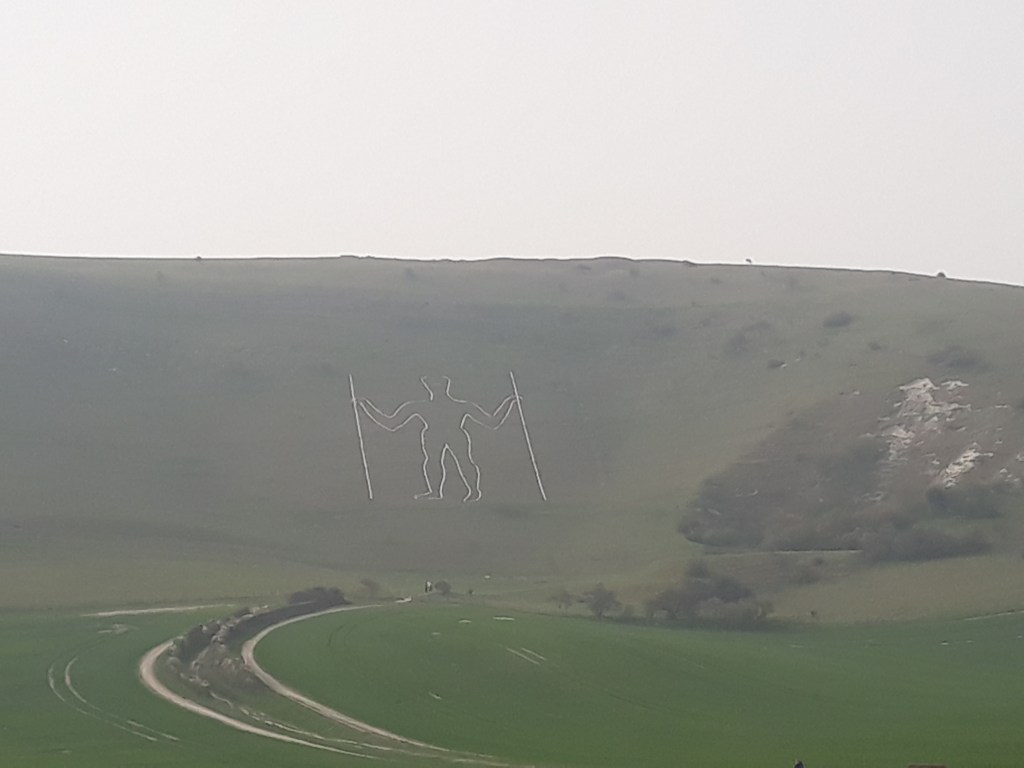
The rollercoaster hills continue and after leaving Jevington the climbing is steady up Combe hill (628 feet) and then Willingdon hill (659 feet) by which time you can see Eastbourne down to your left, and the end is in sight. Another mile or so, and you come to a small but familiar landmark to Wealdway walkers – a brick built seat by a golf course.
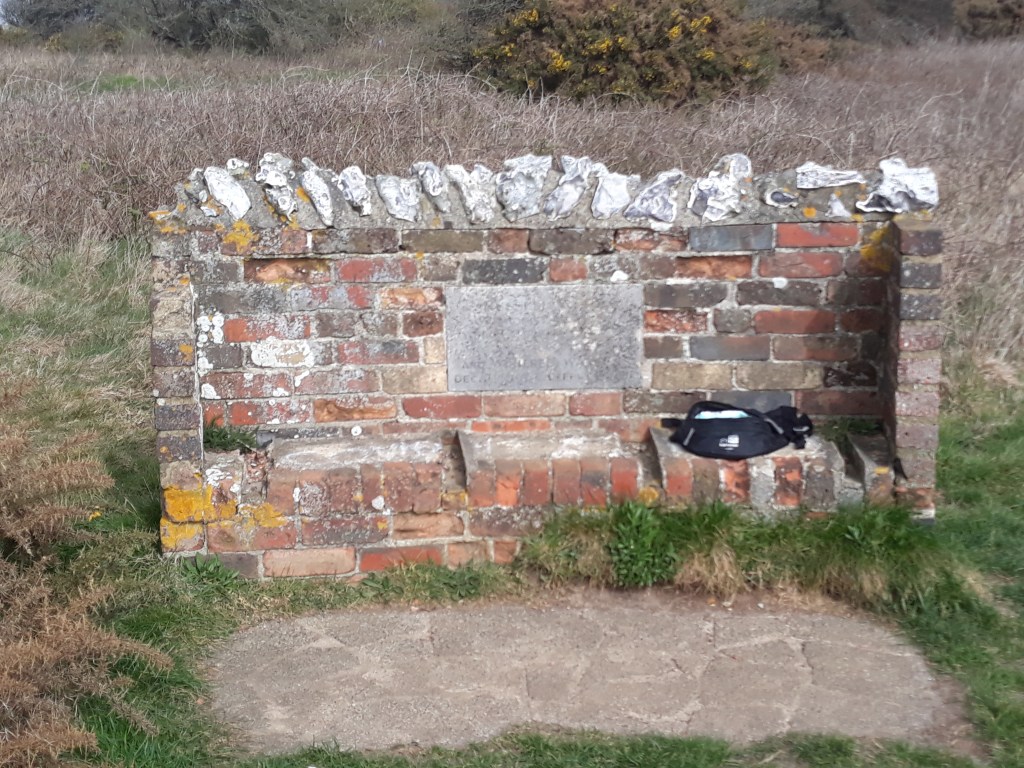
That seat is the signal to turn left and descend the last several hundred metres to the welcome sight of the finish. Job done!
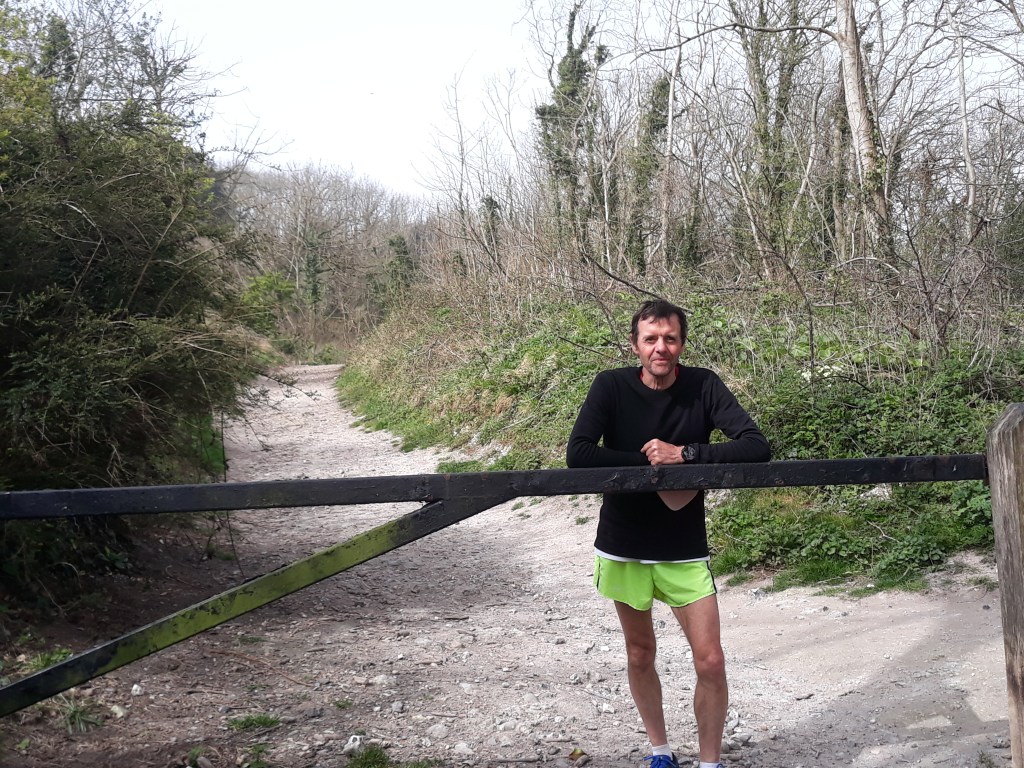
Posted by50000milesontherunPosted inUncategorized4 Commentson WealdWay 2021 – final dayEditWealdWay 2021 – final day
WealdWay 2021 – day 3
After 50 miles in two days, my quadriceps (and a few other muscles) made their displeasure known during yesterday evening, and even walking was a challenge when I got up this morning. But applying Voltarol gel to almost every moving part seemed to help a bit, and I drove back to Five Ash Down to carry on where I left off yesterday. Quickly through the beautiful Buxted park and dropping down to pass the first of a few hidden gems – Hempstead Mill.
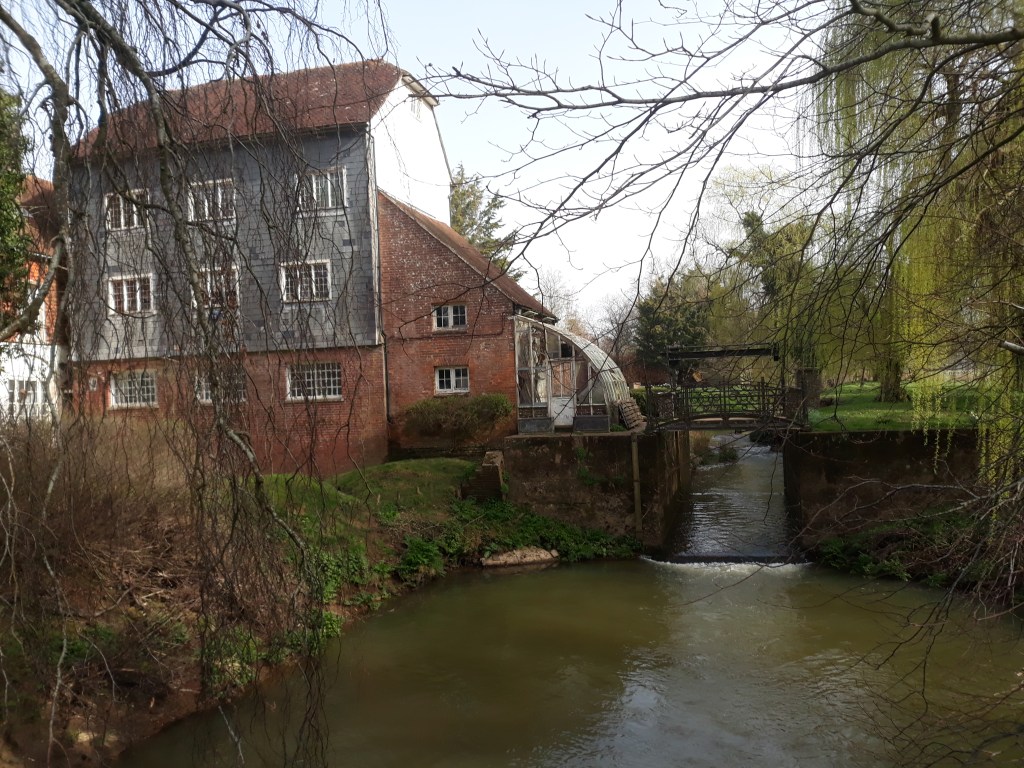
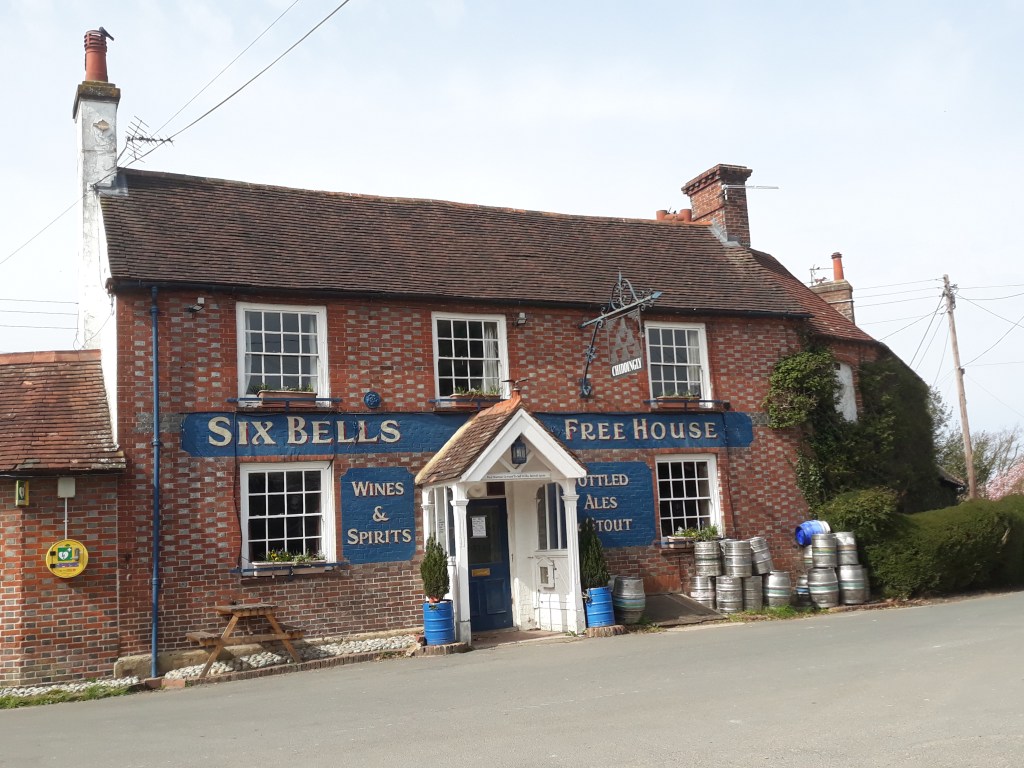
This former mill sits on the tiny river Uck and is tucked away down a dead-end lane just outside Uckfield, so is undisturbed by traffic. Today’s stretch of the WealdWay has little in the way of spectacular scenery, but passes through mile after mile of peaceful farmland and is very tranquil and remote in places. In undulating rather than really hilly countryside, there are also some small villages and hamlets that you’d probably never find if you didn’t go looking for them. Chiddingly is a lovely example and I allowed myself a ten minute stop there to break up the run.
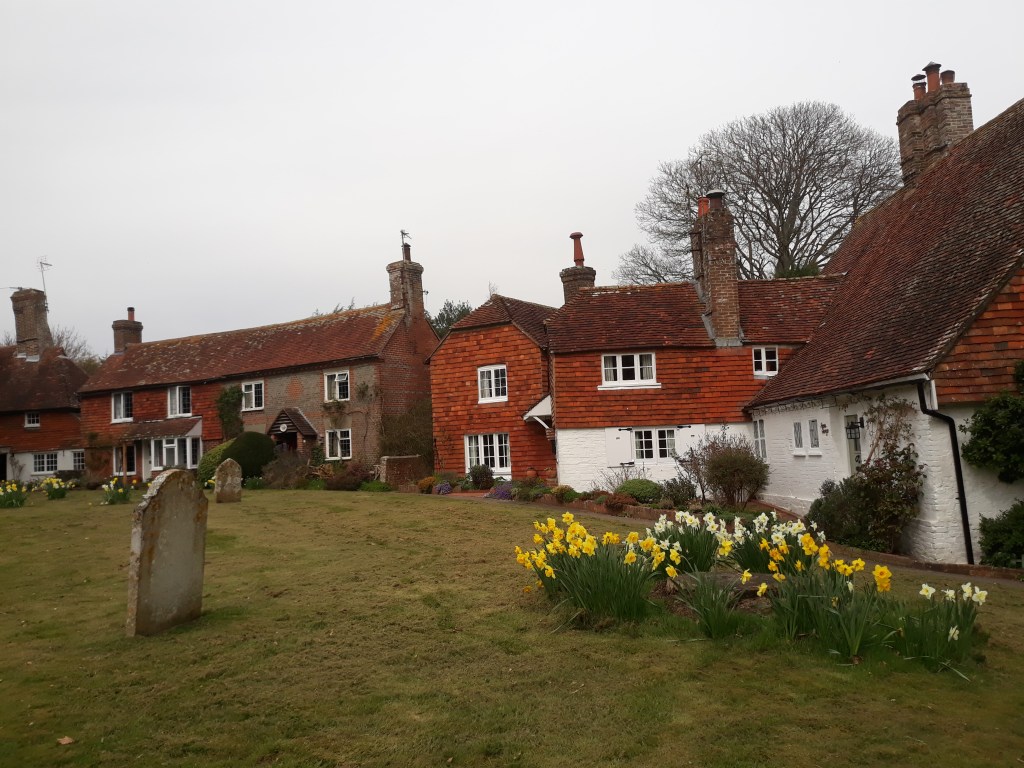
Another little beauty spot is the church at Hellingly, with a crescent of lovely cottages surrounding the churchyard.
I managed to keep up the slow, steady pace again and reached the end of today’s leg on schedule, 68 miles under my belt now since Monday leaving a very modest 12 miles left to cover tomorrow – although it includes plenty of climbing as the South downs have to be crossed, so the landscape will be very different. See you tomorrow.Posted by50000milesontherunPosted inUncategorizedLeave a commenton WealdWay 2021 – day 3EditWealdWay 2021 – day 3
WealdWay 2021 – Day 2
Feeling naturally a bit achey and weary this morning, but once I hit the trail again at about 09.00 from Tonbridge, I was relieved that the ankle problem that had dogged me yesterday didn’t feel too bad at all. Already in glorious warm sunshine under a crystal clear blue sky, as I made the steep climb up on to Bidborough ridge after 3 miles I turned to get a shot of the Medway valley and tried to imagine the path across the valley that I was treading yesterday.
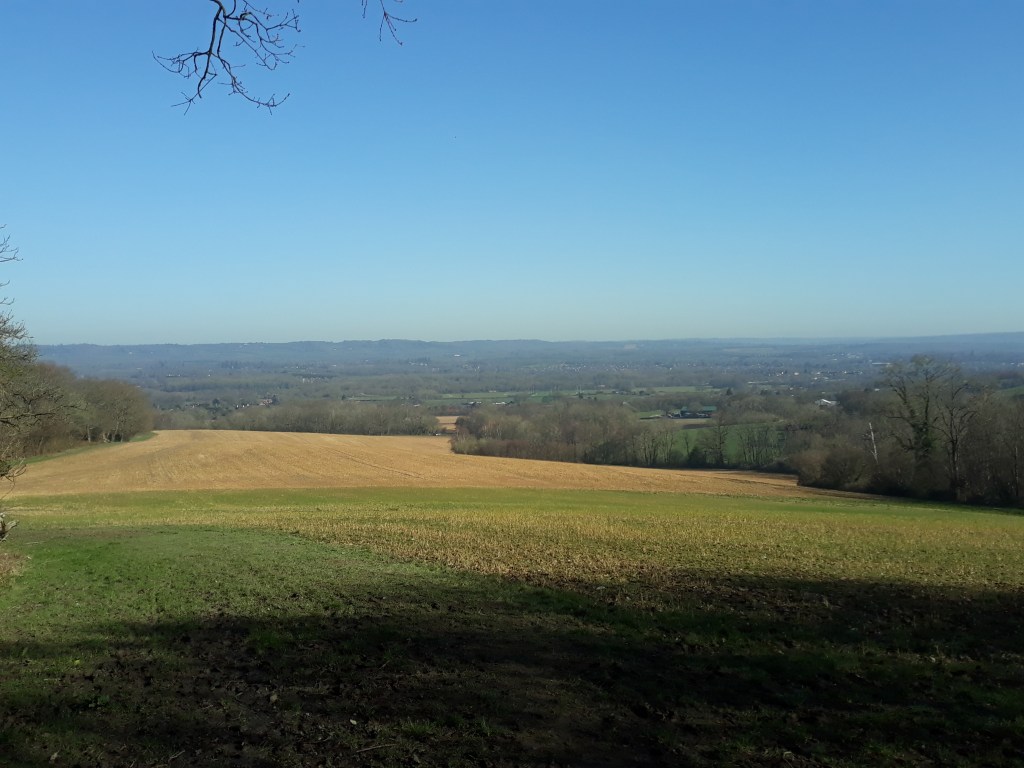
A few steep ups and downs before dropping for a couple of miles alongside the now much smaller river Medway, crossing into East Sussex. A real boost after Withyham as I was joined by my old mate Andy Howey for the long slog up to the top of the Ashdown forest.
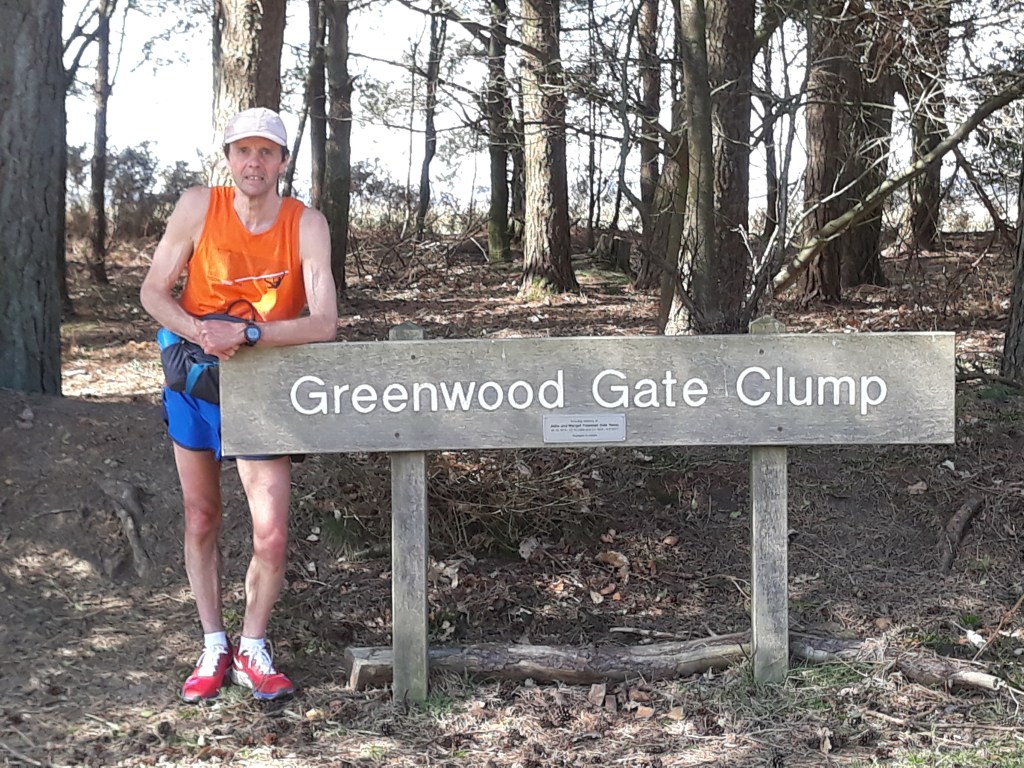
The easy conversation took my mind away from the physical discomforts and what could have been a really tough stretch climbing to the highest point on the entire route passed by painlessly.
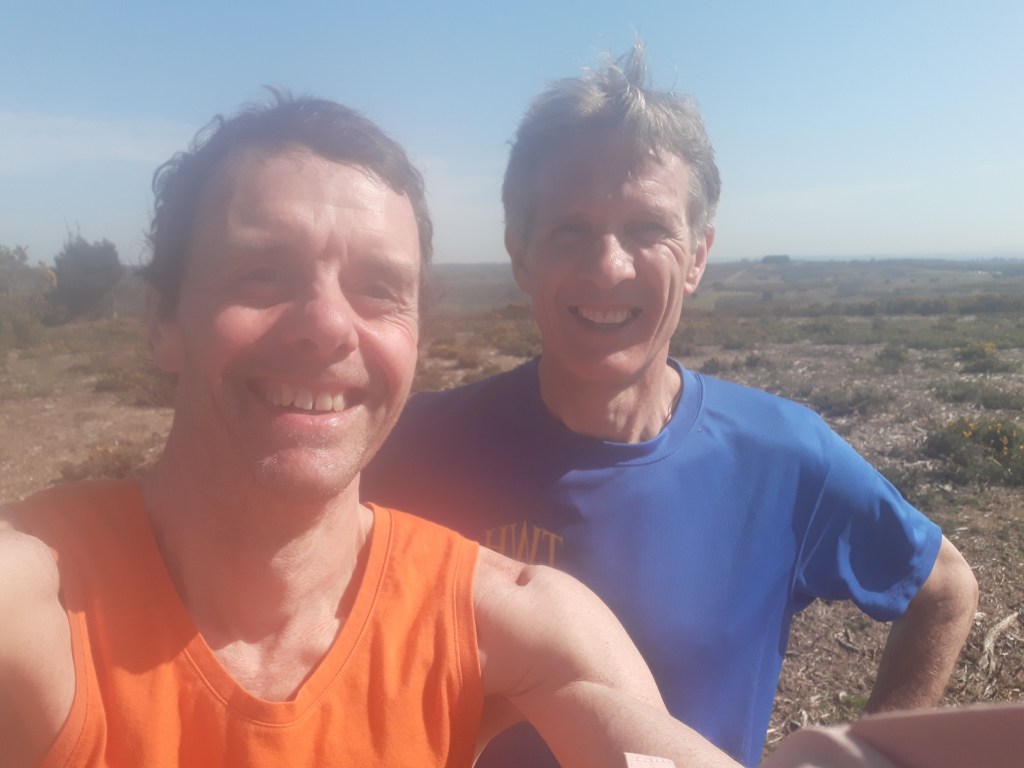
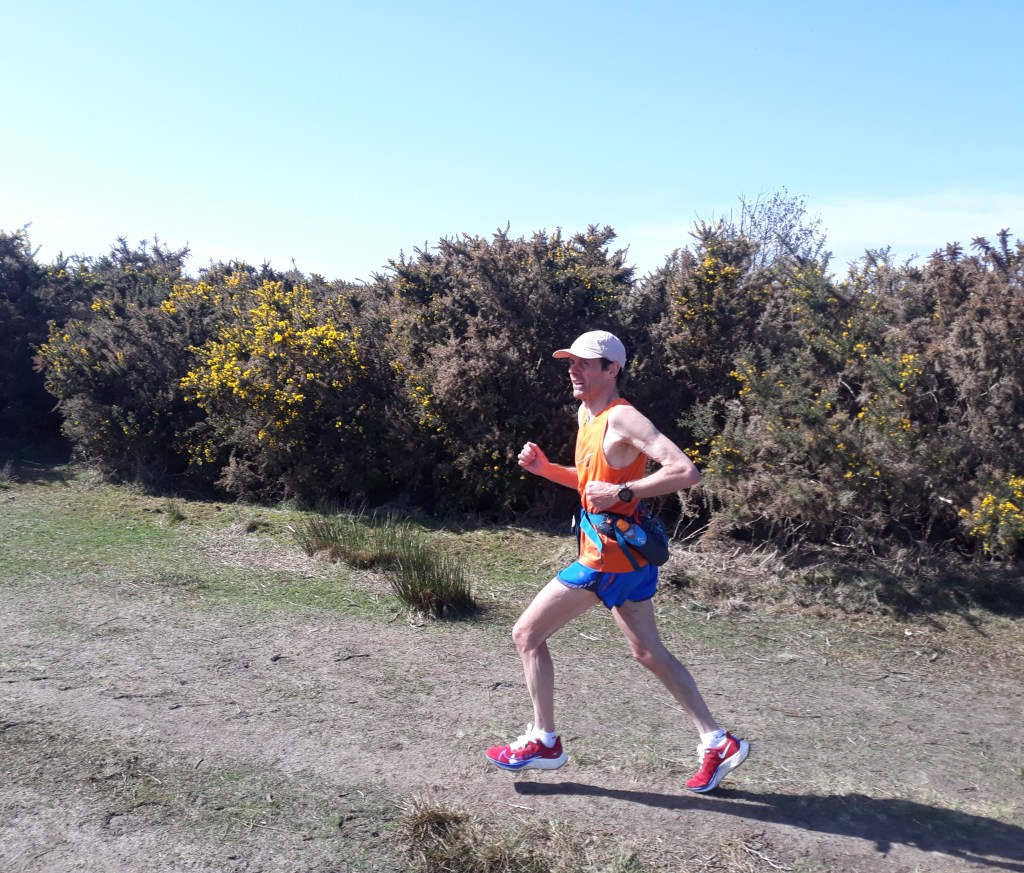
Once over the other side of the forest the route generally descends through fairly remote woods and farmland and some tricky route finding in places for about 5 miles until I reached today’s destination at Five Ash Down after about 22.5 miles. The four day schedule means that tomorrow’s run is reduced to 18 miles, which again looks like being a warm sunny day.Posted by50000milesontherunPosted inUncategorizedLeave a commenton WealdWay 2021 – Day 2EditWealdWay 2021 – Day 2
WealdWay 2021 – Day one
Because my preparations for a 3 day schedule had been so disappointing, at short notice I came up with a “plan B” which would allow for a fourth day, by taking a bit of the heat out of day’s one and two. A bit of last minute rearranging of transport times and pick-up locations meant that I could cut the day 1 distance down from 33 miles to 28 miles, finishing at Tonbridge rather than in Southborough. Day two also reduces from 27 miles to a more manageable 22.5 miles. With that being the hastily re-jigged plan, I was on a bus at 7.25 this morning, to make the train connection from Tonbridge up to Gravesend. A short walk to the start and a couple of photos of the river Thames waterfront at about 9.30
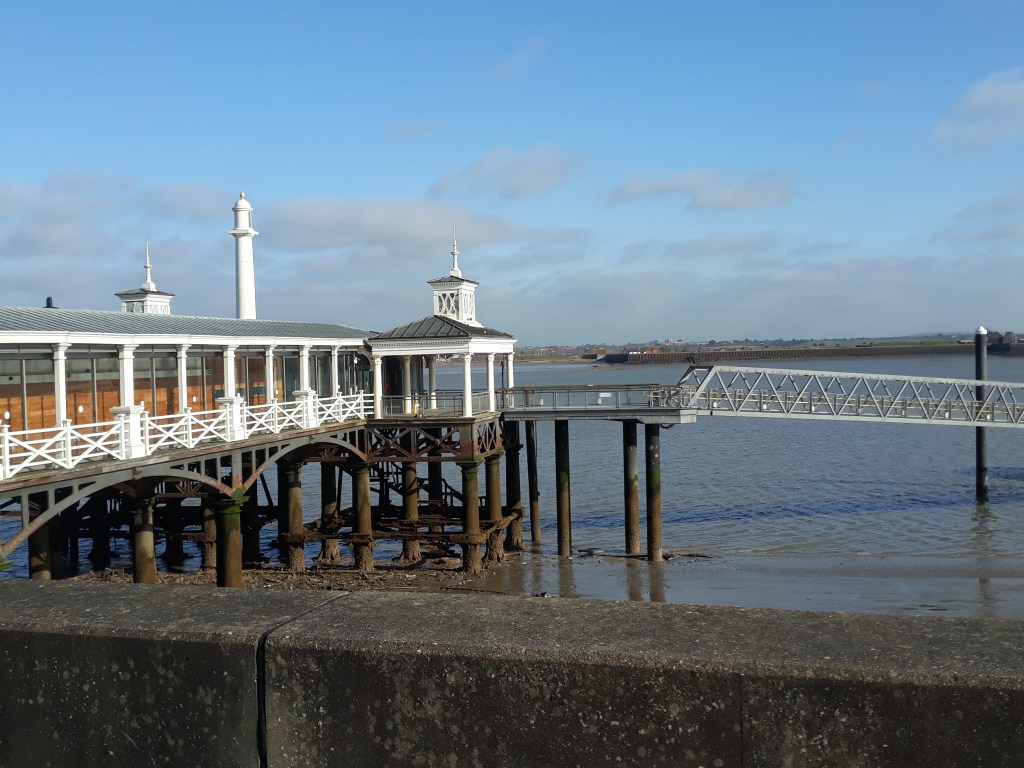
before turning and heading south for the day’s new destination of Tonbridge Castle. I’d anticipated some problems with hips and knees, which have been giving me some pain in my recent longer training runs, but they weren’t too bad. Unexpectedly, I suffered almost from the first mile or two with a lot of pain in my left ankle, which continued throughout the run and slowed things pretty badly.

The weather was great and although it was a bit of a slog toward the end, I made Tonbridge Castle in 5 hours 40 minutes.

Feeling a bit tired now, but should be OK to get on with it tomorrow for a jog up and over the Ashdown forest to finish at the village of Five Ash Down. Update tomorrow.Posted by50000milesontherunPosted inUncategorized2 Commentson WealdWay 2021 – Day oneEditWealdWay 2021 – Day one
on the subject of…..local heroes
It has always seemed to me that for a small town with a modest catchment area, Tonbridge and district has punched well above its weight when it comes to producing very top quality athletes. The credit for much of that must be due to the formation in 1947, and continued flourishing of Tonbridge AC. From small beginnings in its early years it has grown into a strong and successful club with a large membership who benefit from an excellent HQ and track facility which the club shares with Tonbridge school. But I suspect it is the excellence of the strong coaching and support network that has always existed there that really explains the great successes that have been witnessed down the years.
So, here’s just a handful of names and achievements that have been nurtured by TAC, with a tip of the hat to a supporting cast of local athletes from Tunbridge Wells Harriers and Paddock Wood AC who all contribute to the thriving athletics scene in this corner of Kent. Apologies to the many more that I haven’t mentioned.
Val Walsh (as she then was) – Represented Scotland in the Heptathlon with great credit in the 1986 Commonwealth Games.
Tim Berrett – Tunbridge Wells born, he competed to a good standard on track and cross country for TAC before turning his attentions to race walking, at which he excelled. Relocating to Canada, he represented them in an incredible 5 consecutive Olympic games and 9 successive World Athletic Championships.
Tom Bosworth – Another Olympic race walker, still very much at the height of his powers, he holds three World bests including the World Best for the 1 mile 5:31.08. He also holds six British records, has won twelve British Championships gold medals, a silver Commonwealth Games medal and is a World European Olympic Games finalist. He is currently ranked 1st overall in the UK for 20 km.
Mark Steinle – Another Tonbridge born Olympian, Mark competed in the marathon for Britain in the Sydney Olympics in 2000 and was first Briton home in 3 consecutive London Marathons, scoring a PB of 2hrs 09’ 17” which still compares favourably with almost any British marathoner to this day.
Andrew and Allen Graffin – Southborough boys who both competed internationally in the middle distances, with Andy representing GB in the 2000 Sydney Olympics at 1500 metres.
Mark Scrutton – Another great Tonbridge distance runner of the 80’s and 90’s, competing internationally and setting a road 10k time of 27’55” in 1984, which stood as a British record for 25 years before finally being eclipsed by Mo Farah in 2009.
Kelly Holmes – When it comes to local heroes, they don’t get much more heroic than Kelly. I first became aware of her when I started training at the TAC track, and although still very young, she was already being recognised as a great potential talent. She certainly realised that potential, culminating of course in her legendary double gold Olympic medals in the 1500 & 800 metres in the 2004 Athens games. No need to say more !!!
And just behind that roster of great athletes are the countless number of super talented athletes from this area – too many to name – who may not have quite hit the very highest peaks in the sport, but who have, over the years represented club, county, region and country to a very high standard.Posted by50000milesontherunPosted inUncategorizedLeave a commenton on the subject of…..local heroesEditon the subject of…..local heroes
Wealdway diary notes #3
Well, it’s almost time to get on with it!
Since my last update in late February, I’ve managed Sunday runs of 18, 20, 21, 20 which have been OK, but not very encouraging. I had hoped to get up to about 25 miles, but I just haven’t managed it. At the end of each of these Sunday efforts I’ve felt pretty well spent and haven’t really been able to run the next day. So the thought of Monday being much further and then having to do it again on Tuesday and again Wednesday seems pretty daunting.
BUT – I’m feeling pretty good, and for late March, the weather forecast for the coming week is unbelievably good, so the weather gods are smiling on me. It’s just a matter of getting to the waterfront of the Thames at Gravesend on Monday morning and turning round and heading south. If things go to original plan, I hope to cover approximately 33 miles on day one. (Scary – wish me luck!!!)
I’ll aim to post a brief update each evening just to record how things are progressing.
See you Monday night !!!
on the subject of…..cross country racing
I’ve posted previously on the general subject of racing, but there is something special about racing cross country which I think makes it sufficiently different to warrant its own piece. If you are on a track or in a road race, everyone is facing pretty much identical conditions and there’s really no variation in the external or underfoot conditions that can come into play to help or hinder you. That’s very much not the case when you’re battling your way round a “midwinter, ankles deep in mud, leaping across a stream” type of cross country race! In these situations, a bit of forward planning combined with a ruthless streak really can improve your chances of a good race.
As an example, early last year I ran a race that involved having to negotiate about 4 very murky looking drainage ditches of varying width and unknown depth and substance. The first couple were just narrow enough that by summoning up all available resources, you could reach the other bank with a mighty leap. The third was that little bit wider and was down a steep sided bank. At the routed crossing point, it was just too wide to clear in one jump, but by veering just a couple of metres to the right it was just about do-able. This is where the choice of either forward planning, or ruthlessness determines your course of action (I used one of these tactics but I’m not saying which).
- If you’d done your pre-race reconnaisance you’d already have planned your route and that minor deviation to the right gains you 3 or 4 places and 20 yards advantage at a stroke.
- If however you have a merciless nature and time it right, you can tuck in 3 yards behind the guy in front and as his doomed attempt to reach the far bank ends embarrassingly in full submersion, his head will resurface to make the perfect stepping stone, which enables you to cross without breaking stride. Elegance personified.
Even when conditions aren’t quite that challenging, a gentle pre-race warm up jog covering as much of the course as possible will help you choose the path of least resistance, find the drier patches and help you to steer clear of the most sapping stretches of mud. In the stress of the race, this “intel” can pay dividends.
Finally, a story of one fairly extreme bit of pre-race prep that helped me many years ago. I used to regularly run in the annual Northdowns 30k race near Gravesend. The route has changed since, but in those days, the course was essentially a first 13 miles of fields and woodland followed by 6 miles of road. In the year in question, despite being held in late June, there had been a lot of rainfall in the fortnight leading up to the race, so on the morning of the race I drove to the point where the course rejoined the road and hid a pair of lightweight road racing shoes in the hedgerow. When I reached that point in the race, after 13 miles of wet and mud in saturated and heavy shoes it was a joy to change into lightweight, dry road racing shoes. I noted after the race at the time (I think with no exaggeration) that I lost 30 seconds changing shoes, and gained at least 10 minutes and many places over the last 6 miles from the physical and psychological boost that the change made. A bit of planning can go a long way. See you next week.Posted by50000milesontherun
on the subject of…..the 3 peaks (part 3)
While the second attempt had been much more successful than the first, I still felt that with the right preparation, determination and fair share of luck, I could do it quicker. Putting such thoughts to the back of my mind for a couple of years, until in 2018 I suggested the idea of a third and faster attempt to Andrew and Jack for June 2019. Jack was instantly game for the idea, but as my scheme necessarily involved the element of running as much as possible, Andrew’s flat out NO was convincing. However, he characteristically offered to be the dedicated driver if Jack and I were to go ahead with the idea. I set to work on planning timings, accommodation and transport arrangements, this time all geared towards making a quicker time more achievable. The most obvious change was to take the North to South route, but again I avoided the conventional timing, by starting at Ben Nevis at 10.00 am. This meant that if we could be up and down pretty quickly, and get a decent drive down to Wasdale head, we’d be able to do Sca fell pike in the evening before darkness fell, before doing a short night drive down to Wales and starting the ascent of Snowdon in darkness.
I set an ambitious schedule which, if achieved would get the job done in 20 hours and 15 minutes. It looked tough but do-able, so long as we encountered no problems travelling between the mountains – but that would probably be beyond our control anyway.
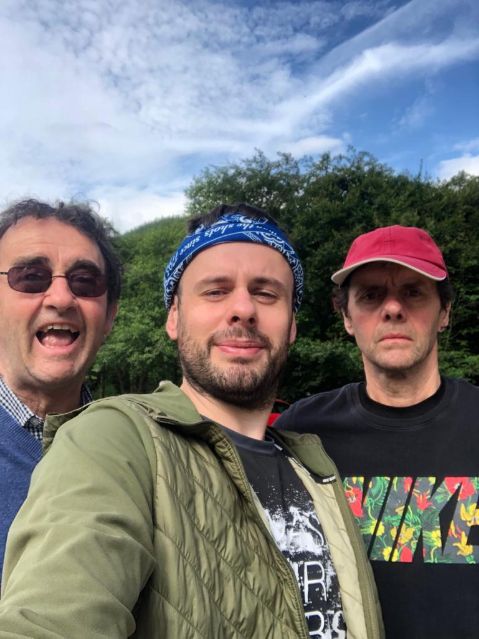
The only problem with choosing the weekend of 22nd / 23rd June is that so many other people do the same, attracted of course by it being the weekend when the longest amount of daylight is available. This meant that there were slow moving queues in one or two parts of the steep drag nearing the top. We were polite enough not to push anyone off the mountain if they got in our way, but we settled into a good pace with bits of running when we could, and were up and down in 3 hours 39 minutes, helped greatly by the summit approaches and peak being snowless for the first time in 11 years !
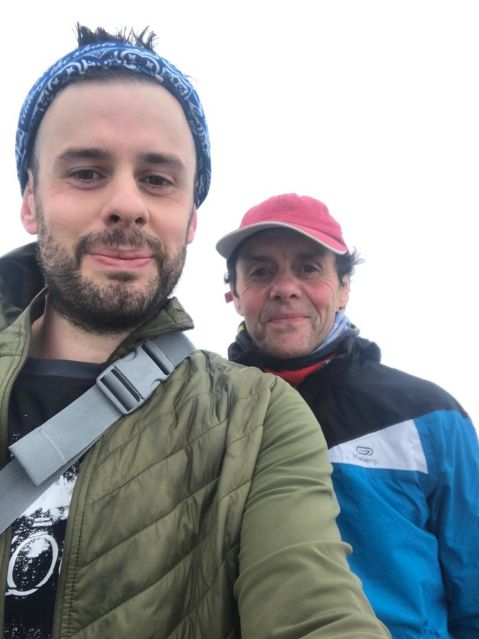
With a pretty quick turnaround at the base, we then set off on a trouble free trip south, and by the time we arrived at Wasdale head, we were exactly 1 hour up on my projected schedule. A decent paced climb to the top, for a quick selfie in beautiful evening sunshine,

and back down again to leave the car park now an hour and 5 minutes ahead of the game. Maybe because we had some time in hand, we allowed ourselves a rather generous 15 minute stop at around midnight to get petrol, food and a coffee on the run, but with an otherwise uneventful journey we still arrived at Pen-y-pas more than an hour ahead of plan. The downside to that was that the entire ascent up the Pyg track was in total darkness, which slowed things a bit, but hitting the summit of Snowdon at 4.11 am meant that we only had to make the descent inside 1 hour and 49 minutes and we’d do sub – 20 hours. Without pushing ourselves at all, we got down in 1 hour 37, giving us a total time of 19 hours 48 minutes.

Well satisfied, job done. Well done Jack – great team mate. Massive thanks to Andrew for the driving and support. Couldn’t have done it without you.Posted by50000milesontherun
on the subject of…..the 3 peaks (part 2)
After the complete hash we made of our first attempt at the 3 peaks in 2005, Andrew regarded it as a nightmare to which he’d never return. I regarded it as failure and unfinished business, to which I had to return. But it was 10 years before I actually got round to it. In 2015 I floated the idea of having another go at it, and was delighted when not only Andrew signed up for it, but my older son Jack, his partner Maud and Maud’s mum, Odile said they wanted to be part of the attempt too. For reasons of timings and economy, our plan was to all squeeze in to one car, and again do the challenge from south to north. We again set ourselves an unconventional and challenging schedule, leaving Southborough at 1pm to be comfortably ready for a 7pm start from Pen-y-pas up the Pyg track. The weather near the top of Snowdon was again very unfriendly for late June,
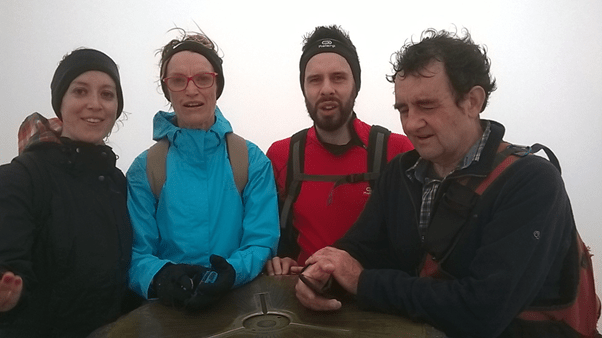
but we were up and down bang on schedule and were on the road for Wasdale Head by 10.30 pm, just as darkness had fallen. This timed perfectly for a short night’s drive to Wasdale head, arriving still in darkness at 02.55am. We made an error by parking a good 10 minutes walk away from the correct start point. Setting off for Scafell Pike by torchlight in cool damp conditions, we worked our way up as daybreak slowly lit the sky. The hike to the top seemed further than I’d expected, and still in semi-darkness route finding was far from easy. The closer you get to the top, the landscape becomes a mass of shattered rocks scattered wildly as far as the eye can see. By the time we made the top, the weather had again become pretty vile with fierce, cold winds howling around us.
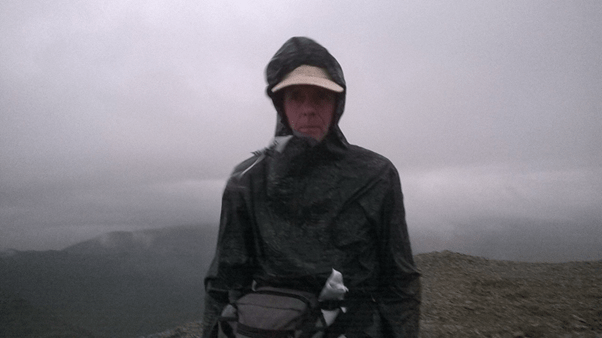
We spent no more than a couple of minutes at the top before retracing our steps back down, during which both Maud and Odile fell several times on slippery wet rock, leading to some bumps and bruises that would later curtail the successful completion for them both. A navigating error on the way back down took us to the car park we should have been in, and further rechecking and re-routing wasted more time before we got back to the car having lost a good 30 minutes on our schedule. At a bit of a physical and psychological low point we were slow getting away, but set off for Fort William with success still possible. We started to think the game was up though, when about 30 miles north of Glasgow we became the back of a non-moving traffic jam for half an hour. By the time we finally got moving again, there were clear differences in the amount of optimism about completing within 24 hours. The mood was further depressed when Odile said that because of the falls on Scafell she was concerned about further damaging a recent shoulder injury so she would not be attempting Ben Nevis. In support of her mum, Maud decided to keep her company and stay at the foot of Ben Nevis. A typically unselfish act, as there is no doubt that Maud would have easily completed the challenge inside 24 hours.
Without further problems we arrived at the foot of Ben Nevis 45 minutes off the pace, but having built in a little “slack” into the time required for the final climb, it was still do-able with 5 hrs 15 minutes left on the clock. As Andrew started to fall off the pace he insisted that Jack and I push on and he’d keep on at his own pace. The weather was bad all the way to the top, and the combination of low cloud, “white-out” snow fields and very low temperature made the last few hundred metres a challenge, but we still made good time. Hitting the summit at about 4.10 pm, amazingly we were completely alone at the top, having been the only people at the summit of all 3 peaks, which I think is a rare achievement in itself!
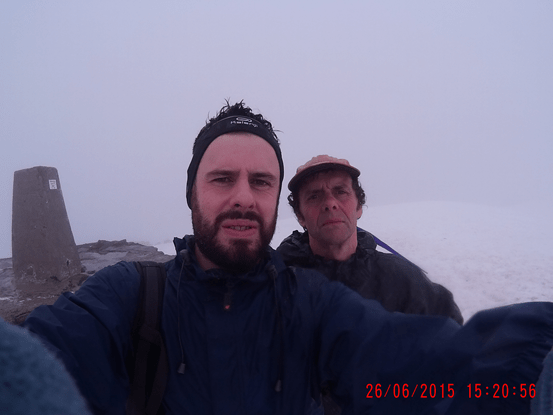
As we descended across the snowfields Jack and I were very pleased to see Andrew approaching. He had made better time up the mountain than we had expected. We assured him that getting down inside 24 hours was still on. We descended without incident and realised we were going to make the time with a bit of margin. Returning to the base we completed the task in 23 hours and 29 minutes, very well pleased. That pleasure was doubled when just 20 minutes later Andrew came jogging in, having made an impressive and fast descent.
Nearly a great result, but once again, I needed to go back and do it faster. Part 3 next time.Posted by50000milesontherun
on the subject of…..the 3 peaks (part 1)
A trilogy in every sense!!!
The national three peaks challenge is to climb the highest mountains in each of Scotland (Ben Nevis), England (Sca fell pike) and Wales (Mt Snowdon), with the necessary driving in between as a single event and to complete it within 24 hours. Many people attempt it as part of an organised group, often using a minibus with non-participating designated driver(s), but it’s possible, and usually quicker, to do it as a small group in one car. If all the occupants of the car are also completing the challenge, there is the added pressure of sharing driving, so not getting much chance of sleep.
The most commonly used method approach is to go North to South, a typical plan looking like this: Set off from the foot of Ben Nevis late afternoon. The hike to the top and back is about 11 miles and can easily take 5+ hours. The idea being to be coming back off the mountain just as darkness is falling. Straight into car and head south to Wasdale Head in the lake district. This drive will also take a good 5 hours or more and is done through the night to minimise time on Sca fell in darkness. The climb up and down Sca fell is the shortest of the three mountains, but is pretty tough in parts and the terrain as you near the top resembles what you might imagine as a desolate lunar landscape, and isn’t easy going. This will be done as day breaks, and if you started your challenge at Ben Nevis at say 5pm, you’d want to be completing Sca Fell and leaving Wasdale head by around 8am. The first 30 to 40 miles out of the Lake district is slow going along very narrow twisting lanes, frequently covered in sheep ! You’ll also probably need a to stop for petrol and grab some food during the drive down to North Wales, so this leg will also take best part of 5 hours. Assuming you arrive at the Pen-Y-Pas car park by 1 pm, you have 4 hours to make the summit of Snowdon and back which is very do-able.
Other strategies are possible, and timing can play a large part in determining success or failure. I’ve done it three times, using very different tactics each time and have had three very different outcomes. But there was a direct correlation between planning and outcome on each occasion. The first attempt in June 2005 ended in abject failure, and went like this:
It would be hard to come up with a worse plan so rather than tell the whole sorry tale, I’ll bullet point the flaws:
- Only two of us, so had to share large amounts of driving in addition to the Mountain hikes.
- Decided to go South to North. Not impossible, but the timings don’t work so well.
- Met up and left Tonbridge at 2am, so already sleep deprived before we started.
- Had no worthwhile maps or routes of any of the 3 mountains. That’s why we lost the path in foul weather half way up Snowdon and had to backtrack to take a different route. We lost 2 hours, and although we didn’t admit it, it was already game over.
- Reached Wasdale head way down on schedule and with dusk falling and with no adequate route knowledge, soon after setting out for the summit we recognised that we couldn’t do it and turned back.
- As the 24 hr challenge was over, we dossed in Carlisle and headed up to Fort William early next morning. A slow slog to the foggy and deeply snow covered peak of Ben Nevis and back down to head back south to try another attempt at Sca Fell, but as it was nearly 11pm by the time we were back at Carlisle, another overnight stop was needed.
- Well into the third day of our “24 hour” challenge as we returned to the Lake District to try and salvage some honour by at least topping all three mountains eventually.
- Unfortunately we still didn’t know the route, and in continuing atrocious weather we got lost at Mickledore (not very far from the summit, but we didn’t know that) and finally gave up, defeated. 24 hr challenge took 3 days and ended in failure. Shambles. Unfinished business. We’ll be back. Part two next time…..
Posted by50000milesontherun
Wealdway 2021 – diary notes #2
Just a brief update on progress towards running the Wealdway at the end of March.
After a pretty depressed start to the year, a month ago I had almost given up on the Wealdway plan, and with the first flicker of interest only coming back to me on the last day of January, the pressure has been on to get things back on track over the past three weeks. Realistically, I think there were only two things I could do to get myself even slightly prepared for the challenge at the end of March;
- Gradually build each Sunday run to get up to something at least approaching 20 miles. From a very low starting point, that’s easier said than done.
- Once a week, make a point of running several miles in the evening and then getting up and repeating the run early the next morning. To get the body used to running again after relatively little rest period.
To that end, my Sunday runs since 31st January have been 9 miles, 12 miles, 14 miles and 16 miles respectively, so the trend is moving in the right direction. The pace of these runs has been very slow indeed, but I’m well aware that for the Wealdway run, speed is of no real importance. The single most encouraging feature of these Sunday runs has been my recovery from them. As the distance has grown, I’ve found they aren’t taking any more out of me and I feel OK pretty quickly. No doubt that the slow pace is a key factor in that.
I’ve also started the other trick of evening/morning back-to-back runs, but so far they’ve been short – 5 milers. The plan is to build them to sixes, sevens then eights over the next four weeks. The welcome increase in daylight before and after work is helping, as are the improving temperatures of the past week. This morning’s 16 miles was run along a section of the Wealdway route, to re-aquaint myself with it, and was in a mild 13 degrees and a bit of sunshine. Spring is on it’s way.Posted by50000milesontherun
on the subject of…..the track
If you’re going to compete on a running track as an adult, ideally you need some ability and the courage to expose your abilities in an arena where there’s no place to hide. Whether you race well or are having a nightmare, spectators are witnessing it at close quarters.
To do so when you have virtually no such ability requires something else. Arguably you need even more courage to put yourself to a test that you know you aren’t equal to, but it needs to be balanced with an element of masochistic stupidity. I speak from experience.
At my very best I was a truly mediocre track runner. A schooldays experience of setting off at the start of an inter-schools 1500 metres race, and within 50 metres realising the others were running at a pace that matched my 400 metres PB is something that sears itself into the memory. Realising that you’d started a race as a competitor, but within 30 seconds have become a spectator, as you struggle round alone for 3 seemingly endless laps is a pretty demoralising experience. Or maybe character building?
I returned to risk humiliation on the track fairly regularly during my years with Tonbridge AC and having found my level as a “B” string runner in the second team, it ended up being a whole lot of fun. At that level, your preferred event may be the 5000 metres, but you can be certain that lack of numbers in your team will mean that you’ll be called upon to compete in some events to which you may be singularly unsuited. Despite never claiming to be anything other than a very average long distance runner, during those years competing for Tonbridge, in addition to 5000m, 3000m steeplechase or 1500m, I’d sometimes have to do a 400 metres hurdles or even a sprint if numbers were really short. I was generally spared the 110 metres hurdles as the height of the hurdles was roughly the same as my personal best for the high jump. Then there were the field events of course. With the team manager’s encouraging words of “just have a go to score a point for the team” ringing in my ears, I threw the javelin, discus, hammer!!!, shot putt, did the high jump, long jump, triple jump and even pole vault (not always all on the same afternoon you understand). If you were willing to perform badly at enough events, it was possible to achieve a fair number of points for the team. Being a good loser has its advantages.
The veterans athletics leagues give those who wish to continue their track and field exploits into later life the opportunity to do so, generally in a lower key and more relaxed setting. Age grading helps greatly, and everybody recognises that just rising to the challenge of turning up and having a go is an achievement in itself. So I guess it shows that as long as you don’t get into the wrong race too often, there is space on the track for everyone.
on the subject of…..running shoes – gettin’ sentimental…
OK, I admit it. Having sentimental memories about long deceased running shoes is a bit weird, but I bet I’m not alone in looking back over the years and remembering shoes that were just so damned good you wished they’d last forever.
When you’re making your decision about your next pair and preparing to hand over a fair wedge of your “hard earned” you persuade yourself they feel just perfect. But sometimes after a few weeks of running in them, you’re thinking maybe they aren’t so great after all and are looking forward to your next pair, or harking back to some favourites from your past. The expensive mistake (I have a pair of Nike Air 70 React that feel so wrong I can’t even walk in them) is inevitable, but hopefully rare.
There’s a heavy bias towards racing shoes in my favourites list. I guess that’s because they are usually a super lightweight model that makes the very act of putting them on, a statement of intent. You drive a Ford Fiesta most of the time, but the e-type comes out of the garage on sunny days. The one thing they have in common is that at some point during the last 40-odd years – I loved ‘em!
There are one or two big brands I’ve never got on with – Adidas being the main one. I also rarely found a Brooks shoe that felt right, and even Reebok didn’t quite do it for me, but I’ve had enjoyable mileage out of several other brands – Saucony, Mizuno and even the cheap and cheerful Hi-Tec Silver Shadow, which I believe was a very under-rated shoe. A tip worth trying which can make an average shoe feel like a favourite is to retain good insoles from previous shoes, which have moulded to the shape of your foot and transplant them into a less comfortable shoe. I’ve improved the feel and longevity of plenty of pairs by using this trick. Of the everyday road training shoes for the bulk mileage, my favourites have nearly always been Nike or New Balance. A fairly early incarnation of the Nike Pegasus with a waffle sole and a very cool Navy blue, red and silver colouring were an early favourite. I owned 2 or 3 pairs of Asics Gel 101s in succession around the late 80’s early 90s which were just great, and many New Balance models have been favourites too, but which because of their “numbers” method for naming their models – NB 480, NB 630, etc etc – have been lost in the haze of time. But my gallery of much lamented favourite racers includes:
Karhu Stardust – A Finnish brand. Ridiculously lightweight racing shoe, about 155gms – much firmer midsole than most. Circa 1983
Ron Hill 208 – Soft, spongy, V. light. Circa 1985
Nike Terra – Probably my all time favourite shoe. About 160 gms. So soft and cushioned that even my skinny weight crushed them. I’ve never really got over it.
Nike Duellist – Memory says this was probably the lightest shoe I ever wore – about 140 gms maybe ? Midsole tapered away to nothing under your toes, with an upper that felt like tissue paper. White and pale green – a real good looker. For 10K or shorter.
Nike Air Mariah – The Duellist’s big brother. Still light(ish) but with an air cushion, so good for anything up to Marathon distance.
New Balance Fresh Foam Beacon – At the pace I run nowadays, a racing shoe is an unnecessary indulgence. But I still can’t resist them, and this is my current choice. I like them so much I bought two pairs, and at current frequency of racing, they’ll last longer than I will. Lovely, lightweight and a dazzling red upper above a thick white midsole. A firmer cushion reminiscent of the Karhu Stardust.
That’s a handful of mine, what’s yours ?Posted by50000milesontherunPosted inUncategorizedLeave a commenton on the subject of…..running shoes – gettin’ sentimental…Editon the subject of…..running shoes – gettin’ sentimental…
on the subject of…..ordnance survey maps
Last week I was trying to persuade you to get out into the countryside. If you are feeling tempted, but aren’t too familiar with what lies the other side of the hedgerow then the best idea is to pick up a copy of the Ordnance Survey map from the Explorer series, which covers your immediate area. There are a staggering 140,000 miles of public rights of way – including footpaths, bridle paths and by-ways in England and Wales, with over 4,200 miles of them in Kent alone, so if you’ve ever driven past a footpath sign by the roadside and thought “I wonder where that goes?” the answer can be found in these maps. They have a scale of 1:25000 which is 2 ½ inches to the mile as you view the map so there’s plenty of detail in them. The complete set of 403 maps covering the entire country is currently on sale at a special offer price of £2650, but let’s take this one step at a time! £8 or less will get you your local map. In it you’ll find a treasure trove of information covering all roads, footpaths, by-ways, cycle routes, long distance trails and other public access routes. Printed in colour to make it easy to distinguish between built up districts, woodland and forest, farmland, rivers, ponds and lakes and with roads colour coded to show their classification. If you’re planning some medium or long distance walking or running, you really can’t do without explorer maps.
Every imaginable feature is shown – View points, pubs, churches, bus and train stations, quarries, embankments, ancient monuments, castles, ruins and battlefields, and down to more prosaic things such as telephone boxes and electricity lines and pylons (very helpful when route finding). Contours shown at 5 metre vertical intervals tell you if you should expect a flat walk or run, or be prepared for some strenuous climbing. And you can polish your map reading skills by checking your position or destination against the national grid reference lines which are featured.
The maps are covered with symbols to help if you are looking for available leisure pursuits and tourist type information such as National trust / English heritage sites, public gardens, camp sites, visitor centres, sports centres, theme parks, picnic sites, golf courses, fishing, horse riding etc etc. The list goes on. And before you ask, no I’m not on commission from Ordnance survey sales dept!!! But anyway, get even more info at www.ordnancesurveyleisure.co.uk
Wealdway 2021 – diary notes
Sometime during 2020 the idea came to me to have some sort of revisit of my 1986 running the Wealdway end to end. I’m certain I don’t have the physical capability and definitely don’t have the inclination to put in the sort of mileage preparation that would be needed to tackle it as a one day attempt, so I worked up a plan to cover the approx. 82 miles over three consecutive days. By undertaking it as a solo attempt with the least possible external support, it still felt like a major challenge to work towards. Put simply, the plan would look like this:
Day 1. Drive to Paddock Wood. Train to Gravesend. Walk to the Wealdway starting point on the river Thames waterfront and then turn round and set off along the route. Day 1 being significantly the longest leg of the 3 day journey south, crossing the hills of the North downs before dropping down to the Medway valley, the aim being to get back to my home in Southborough, which by good fortune lies on the route. A short detour off route back to my house would total approximately 33 miles.
Day 2. From home, rejoin the route and then continue south across the weald and climbing to the highest point on the trail at the top of Ashdown forest, continuing on to conclude the day somewhere beyond Uckfield after a day of about 26 miles. A lift back to my car in PW (thanks Andrew, as always) then a drive home.
Day 3. Drive back to park at the day 2 finish point, and then continue the relentless push south for about 24 miles to face the hills of the South downs and run through some of the tiny hamlets tucked away in the east Sussex countryside, before the final descent down to the finish on the English Channel coast at Eastbourne. A lift back to my car, drive home. Looks easy enough on paper.
I felt that so long as I still fancied the idea by New Year’s day, I’d pretty much commit myself to doing it (injury or illness permitting) and that a general increase in mileage, and specifically individual long training runs would have to start from early January. From a starting point of very few recent runs beyond 8 miles I did a steady 13 miler without trouble but then descended into a malaise that dragged me down by mid-January. Suffering a complete loss of desire to run, I took some of my own advice and only did a couple of gentle jogs over a two week period to wait for the hunger to come back. Today – 30th January – was the first day for over 3 weeks where I felt I’d like to run, so despite the grim weather I managed a gentle 3 miles, which was enjoyable apart from having to deal with a mid-run nosebleed . I’m very conscious that to prepare for 3 very long runs on consecutive days with no real recovery, from my current position is a bit pressured, but at least today I feel again that it’s a challenge I want to have a go at.
I’ll update this “blog within a blog” mini diary here and there over the next few weeks with either progress or lack of progress !!!
on the subject of…..the countryside
Running doesn’t all have to be about “training”. And it definitely doesn’t all have to be on the road. The countryside is where much more fun can happen.
Road and pavement is the right environment for when your session involves the need for outright speed or a quick tempo training run, as it gives consistency and as long as you avoid the potholes you’ve got a nice steady surface which means you needn’t turn your ankles. But if you just want to breathe in the air, slow the pace down, take in the scenery and find a bit of peace and quiet whilst still getting your necessary dose of good exercise, get out in the country and set enjoyment as your priority. I’m lucky to live in Kent, and whilst it may be arguable nowadays as to whether it still deserves it’s famous “Garden of England” tag, it is still a fact that in most of Kent, you don’t need to travel far from your front door to find plenty of unspoiled and tranquil countryside. And although it’s a densely populated county, once you get off the road and head onto footpaths, fields and woodland you don’t meet very many people. If you’re not in any hurry, the unpredictable underfoot conditions you may encounter only add to the feeling that compared to road running, this is a very different experience. You may need to plunge your shoes into a bucket of soapy water at the end of it, but it’s worth it.
If all of that sounds too easy and a bit too much like fun, you can still use it as a hard work session if that’s what you want. It’s a perfect way to do fartlek sessions, where it becomes easier to combine the twin aims of putting in a mix of fast pace bursts and recoveries over a variety of distances and yet enjoying your surroundings as you go. You can work out a short cross country circuit for repetitions, and cross country runs are always good for building up stamina as the added resistance of the often challenging underfoot conditions give a good workout to muscles which are normally less stressed. If you aren’t too familiar with the off road routes in your neighbourhood, I recommend getting the Ordnance Survey “Explorer” map that covers your area. The best £8 you’ll ever spend, and I’ll talk a bit more about them another time. (Old blokes love maps!!!). So if you are lucky enough to live close to the countryside but haven’t yet ventured off the roads, what are you waiting for? Get out there !
next up (as promised) – on the subject of…..the explorer maps
on the subject of…..a bad patch
You’ll be very lucky if as a runner, you don’t go through the occasional bad patch. I hadn’t planned for this week’s post to be on that subject, but as I suddenly find myself struggling, with every run being slow, laboured and difficult, it feels like the right moment to consider why it happens and how best to deal with it when it does. It can be simply a physical thing – general tiredness caused by the everyday stresses of normal life, and so long as this doesn’t continue beyond perhaps a week or so, you should be able to ease back slightly and run through it. Of course if a sudden loss of form or energy combined with the loss of desire to go out becomes more prolonged, it could be indicating a medical issue which may need a visit to the doctor, so don’t neglect that.
But even if the cause is not medical it can still quite quickly become psychological, leading to a vicious circle of poor performance / slow jogging feels like hard work / loss of confidence / no desire to run / reduced training / poor performance etc etc. It can be worthwhile reflecting on your current situation to try to identify what might be causing this negativity. For me, right now I think the fact that we are in the depth of winter, so almost every run is in the dark, cold and usually wet isn’t helping. Even very slow paced runs feel difficult. The fact that there’s little prospect of a return to normal racing or outdoor competition anytime soon is de-motivating and the ever present negativity of the whole Covid situation seems to feed into the general malaise. If you find yourself in this situation, I’d say there are three possible courses of action which I’ll list in order of recommendation:
- Simply accept that it’s inevitable that very occasionally this sort of “slump” will happen, and that the best thing to do is to scale back your running to just a couple of unpressured runs a week for two or three weeks or until you get your “mojo” back. Don’t wear a watch – you don’t need to keep seeing the reminder that you’re running slower than usual.
- Take a complete break. Give yourself the time you need to forget about running for a while. Two, three maybe four weeks? The chances are you’ll soon be more than ready to get back out there.
- Carry on regardless and just keep on with your normal routine even if it is much slower and more difficult in the hope that you’ll “run through it”. This could be the risky option, as if you are suffering some underlying fatigue there’s a high chance of it leading to illness or injury.
I’ve said before that if you aren’t enjoying it running can feel like a drag, so it’s far better to have a rest and get the hunger back than risk burning the desire out.
on the subject of…..a tale of two running gear shops (part two)
Up and Running
Great name. And back then still pretty original. My reasoning behind setting up my version of the early sweatshop was (1) There was an untapped demand for such a shop in West Kent (2) It would happen sooner or later anyway, and if anyone was going to do it, it was going to be me (3) If I didn’t risk it, I’d spend my life wondering “what if…..”, and (4) well, it was just a great idea!!!
So having already formed this half baked idea that I could set up and run a specialist running gear shop, I had now also come up with a good name. That’s most of the hard work done surely? Well, no not really. From a starting point of just below zero I had to start researching the market potential, answering the tricky question of how this idea was going to be funded, doing the business plan / cash flow projection stuff to take to the bank, search for suitably sized and well located shop premises, start establishing contacts with the major running shoe and clothing brands (who didn’t know me from Adam), and learning how these things all worked, whilst holding down a full time job. When the time eventually came, I also had to do most of the refurbishment and restoration of a badly run down shop premises in the few weeks leading up to opening. Enough detail already!
Up and Running opened it’s doors in early 1988 and that was possible largely due to the unfailing support and loyalty of my wife Kim and brother Andrew, who if they doubted the wisdom of going ahead with this crazy idea, were kind enough not to say so out loud! Andrew also invested a significant sum of his “hard earned” in the sure and certain knowledge that he’d never see a penny of it again, and helped in many other ways during the short history of the shop (and we’re still the best of friends !!!) I should also single out the extraordinary generosity of the Nat West bank who having secured my house as collateral, were very keen to lend me large sums of money at extortionate interest rates and continued to offer further advances as the sinking ship went down, safe in the knowledge they could evict me and my family and sell my home. Their kindness lives on in my heart. You live and learn.
The shop traded through a difficult period of economic recession which saw the demise of many High Street “household names” and never quite reached a position of financial stability, but I was gratified by the number of loyal customers, many of whom travelled long distances to support Up and Running. My ethos was to completely know the product – be it shoes, clothing or equipment – so that I could offer genuine and honest advice to my customers. There were definitely occasions where I would recommend against a purchase if I truly felt it was not right for the customer, and would miss a sale as a result. Enthusiastic amateur – definitely. Hard-nosed businessman – I think not! It was probably this lack of business acumen that hastened the shop’s closure in 1992.
Despite approaching 30 years since the shop closed, I still to this day get people come up to me at races and say “you owned the running gear shop in Southborough, didn’t you?” or “those shoes you sold me have worn out, I want my money back!” But seriously, I still have a lot of running friends, colleagues and clubmates that were with me back then and are still around now and I thank you. Too many to single out by name but if you’re reading this you know who you are. Thanks again. Kim.
On the subject of…..a tale of two running gear shops (part one)
The Sweatshop
Olympic gold medalist and founder of the London Marathon, Chris Brasher was ahead of the curve in the late 1970s. He had opened a sports shop a few years earlier, but perhaps anticipating the running boom, it had become focused almost entirely on running gear. The first London Marathon in 1981 was a previously unimagined major event waiting to happen, and it almost single handedly set off the mass participation in running that we’ve long since taken for granted. So having been instrumental in creating the boom via the marathon, when it happened, Brasher’s Sweatshop was ready and waiting to capitalise on it. I discovered the existence of The Sweatshop in 1981 and still recall driving to Teddington and finding this pretty modest sized shop in an otherwise unremarkable suburban shopping parade. Entering it was like walking into Aladin’s cave. I was like a child in a toyshop. Every major running brand name was represented, a huge choice of shoes covered the wall, tons of associated running clothing and equipment that I’d hardly realised existed was all there waiting to be snapped up. Heaven, but for one problem – too much choice, not enough money !
Maybe best of all was that it was very clearly staffed by athletes who knew what they were selling because they were out there every day using it, and were well positioned to give good advice to novice and seasoned runner alike. Whilst being a well stocked and successful retail operation, they had managed to create a relaxed ambience which combined the feel of a shop with the atmosphere of an athletics clubhouse. As it became more and more successful through the eighties and added numerous branches around the country it inevitably lost that “clubhouse” feel in favour of a more corporate branding, but I think that during that first visit back in 1981 a seed had been sown in my mind that this was an environment I wanted to be part of. That seed of an idea lay dormant and only started to develop and take root about five years later when despite having no experience in retail, never having set up or run a business, having no contacts in the sports retail trade, and worst of all having very little money, in fact possessing not one single qualification that would support my doing so, I set out on two years of planning, preparation and groundwork to create my attempt at what I had seen in Teddington those years before !
Next up…..the rise and fall of Up and Running
on the subject of…..looking back, looking forward.
It’s tempting to play this game in the last few days of the year; a look back on what’s just gone and to have a few thoughts about what lies in store in the New Year, but you can be excused from playing it this year if you’re feeling frazzled or fragile! I’ll keep this focused only on running. Looking back, there’s been no part of life that hasn’t been affected by the virus and that includes organised athletics and running, so a quick round up of 2020 for me is that I had just 4 races for the year, should have run my 5th this morning, but the Staplehurst 10 miles was cancelled last week! Managed to keep training throughout the year and should just tip over 1200 miles for the year by Thursday. Going through the 50,000 diarised miles in August was a small milestone. But whichever way you cut it, it hasn’t been a great year. With all that’s happened, and is still happening, it might be unwise to make predictions for 2021, but you have to keep moving forward. I always have a modest minimum mileage target for each new year of 1000 miles which is (give or take) 20 miles per week, and really just hope to stay fit and motivated enough to keep racing as often as I can with the aim of trying to match, or better last year’s PBs. This year though I have a specific target to prepare for in the first quarter of the year. In 1986 I ran The Wealdway long distance footpath end to end in one day, and have decided to revisit the challenge in a “watered down” way. My plan is to do the run again as a solo, unsupported 3 day event on successive days 29th, 30th, and 31st March. In order to be as self contained as possible I will have to add a couple of miles to the total distance, so I think the days will be approximately 33 miles on day one, 27 miles on day two and 22 miles on the final day – 82 miles in total. All subject to being able to get some reasonable training in through January, February and March and staying healthy and uninjured. I’ve also got an idea that I’d like to have a go at the Welsh Three Thousands, maybe as a run? Beyond that, just keep on keeping on at all the usual training and racing I guess – there’s always a chance that my brother Andrew and older son Jack might throw down some challenge to get involved in – who knows? Whatever your hopes and ambitions for 2021 are, I wish you good health and good luck. Next up…..a tale of two running gear shops!
on the subject of…..whatever the weather!
I’m writing this sitting at my kitchen table, mid-evening, midweek, mid-December, contemplating the fact that I’m running twice tomorrow. The first run will be at around 6.30 am to get to work, then the same route in reverse at about 5.30 pm to get back again. So a big consideration for tomorrow is the weather forecast. The morning is forecast dry and mild, but unfortunately it’s expected to change during the day and my run home will be into the face of a strong wind and almost certain rain. Hmmm!!!!!!!!! This is where having the right gear plays it’s part.
I’m not generally drawn in by advertising slogans, but this one caught my eye a few years ago: THERE’S NO SUCH THING AS BAD WEATHER – JUST THE WRONG CLOTHING ! Investing a bit in decent kit makes the worst of conditions a lot more bearable. It really does make going out when it’s cold and lashing down with rain at lot less daunting if you’ve got decent quality lightweight breathable waterproof top and trousers. A couple of layers of long sleeve thermals, gloves, hat and a snood if it’s cold and you’re unstoppable! Basically, if you stay dry and well insulated the English winter shouldn’t trouble you. Cross country running through snow is great fun, and if you’re really adventurous you can do that in the dark as the small amount of starlight or moonlight will reflect off the snow to give some visibility. It’s a great novelty but best to carry a mobile phone with you and let someone know where you’re going if you decide to give it a try. At the other end of the temperature scale, it’s a matter of how you as an individual can handle running in the heat. If you’re fair skinned you may prefer to avoid the full sun of a hot July day, but personally I’ve always loved running in the heat of the midsummer sunshine in just shorts and shoes – great sense of freedom. Ultimately it’s just a matter of accepting that the weather in this country changes on a daily basis, so be ready for anything and learn to enjoy the different conditions. I wish you the best Christmas that 2020 allows, and see you next week. on the subject of…..looking back, looking forward.
on the subject of…..inspirational books
Sometimes when it’s cold, it’s raining and it’s dark outside, even the most committed among us might struggle to find the enthusiasm to get our gear on and step out for the training run we’d planned. When this situation arises ( as it quite often does ) there are usually two options: The first is to draw on your inner strength and persuade yourself that once you’ve got out the front door and made a start it will be OK. This usually works, and usually proves to be the case and when you get back home you’ll invariably be glad you made the effort. The other option is to pull the curtains, put your feet up and relax with a book or the TV. The second option is much more appealing in the short term, and if you’re genuinely feeling a bit jaded might actually be just what you need, but it isn’t a habit that you would want to get into.
So on those occasions when going out feels impossible, but not going out feels like failure, the answer may be found between the covers of a good book. There are so many great and inspiring books with running as their theme that it would be hard for me to single out many as being better than the rest, but as I add to my small but growing library of such books, I’ve read a few that I’m happy to recommend. In my previous posts about ultra running I named three books which are stories of triumph over adversity in circumstances few of us will endure: North by Scott Jurek, Running and stuff by James Adams and There’s no map in hell by Steve Birkinshaw. A few pages of those will soon make the prospect of your 5 miles in the cold and rain seem a bit less daunting.
Christopher McDougall’s Born to Run is a quirky book which delves into the secretive world of the legendary Mexican Tarahumara Indians, famed for their amazing feats of long distance running. A true story, it reads a bit like a novel. Check it out.
Biographies of running legends always make interesting reading: Sydney Wooderson – a very British hero by Rob Hadgraft, Endurance – the biography of Emil Zatopek, The Impossible Hero by Dick Booth which tells the story of the enigmatic Gordon Pirie, and Joss by Keith Richardson – the story of the still unstoppable fell running legend Joss Naylor are among those I’ve greatly enjoyed and recommend.
But the Daddy of them all just has to be “The long hard road” by Ron Hill. Delivered in two volumes as part one “Nearly to the top”, and part two “To the peak and beyond”, this is the autobiography of probably the greatest long distance runner this country has ever produced. For utter dedication and determination over a long lifetime of running he’s unrivalled. Having performed at the very highest level, breaking national and world records and competing in Commonwealth, European and Olympic games, his love of the sport included an almost obsessive hunger for racing, and the dedication to set a record of running every single day without exception for over 52 years, before a heart problem and then the onset of dementia in the past 2 years has finally slowed him down. The book gives a really detailed insight into his life from the earliest days, through his years of triumph and onward into gentle decline. Search the book out online. You’ll be well rewarded.
Next up…..whatever the weather!
on the subject of…..the diary
I had always loved running anyway, but taking part in the 1981 London Marathon moved things to a different level for me. That was when I realised that this sport was going to play a large part in my life and it prompted me to start a diary to record all of my running, training, racing and a few other incidentals that crop up from time to time. That diary started in March 1981, and I still keep it to this day, having recorded in eight volumes (and counting) every run that I’ve done in the past 40 years. For anyone setting out on the early stages of what may become a lifelong running habit, I’d strongly recommend keeping a diary. Not only does it become the place to record the many long hard miles covered over the years, but also to detail different training schedules that are appropriate to the different target you may be working toward at any given time, and to gradually build up a history of what does and doesn’t work for you. And of course, it’s the place where you build up the record of all your races – successful and otherwise. It slowly becomes your own personal history and gives you the opportunity to revisit some of the best and worst moments. Throwing in the occasional photograph with friends and clubmates who drift into and out of your life over the years adds some colour to the story and brings back good memories when you start looking back. Not much more to add, other than to say that if you’re in the early stages of your running life but you can already feel you’re in it for the long haul – start your diary today. I promise you that in 40 year’s time you’ll be glad you did !
Next up…..inspirational books
on the subject of…..the seasons
As we move into December and officially winter later this week, it seems a good moment to reflect on the seasons from a runner’s perspective. I’ve always been a country boy, so enjoying the different conditions that nature creates through the year comes naturally. But getting out there in your running gear is where you can really savour the changes and challenges that we experience each year. While the south-east of England has little in the way of genuine extremes of weather, it’s still very unpredictable and you may run in 30+ degrees sometimes in the summer and minus 5 occasionally in the winter, and heavy rainfall and strong winds happen at almost any time of year so we definitely don’t lack variety. However, it has been very noticeable over the past 30 years or so how much softer our winters have become. Serious, long lasting falls of snow are a genuine rarity nowadays.
Apart from straightforward climatic interest though, the great thing with the change of season is the different disciplines an athlete can focus on as the year unfolds. Years ago when I was racing almost every week, by this time of year we’d be well into the cross country season with regular Kent league matches. It was always a favourite of mine if a race was hosted by Blackheath Harriers, as after the race – usually 2 or 3 laps of Sparrows den park and woods, or maybe a longer trek around Layhams farm – the jog back to Blackheath HQ was followed by a hot shower and then upstairs, passing the larger than life photographic portrait of the club’s greatest son – Sydney Wooderson – to get a cup of tea and bread and jam, while comparing race notes with clubmates. Simple pleasure. Interspersed with these league matches were locally organised xc meets, the South of the Thames race in December, then the Kent county champs kicking off the New Year on the first weekend in January. The Southern champs in February and culminating in the National in early March. That marked the end of winter and thoughts immediately turned to road racing and for me the race that heralded the arrival of spring back in the 1980’s was the Tonbridge 10. Road racing/or starting to sharpen up if you had ambitions on the track would then be the focus for a few months. Road relays were also a feature of early springtime. Races abound throughout March to June and maybe taper slightly in mid summer – partly because some people struggle if the temperatures are high, but also due to holidays. July and August though are the peak season for the track athlete. With holidays done and into September and autumn, there’s again no shortage of road (and off-road) races to choose from, and often some late summer midweek relay events before the evening daylight fades away. And then before you know it, we’ve all completed another lap around the sun and you’re doing your training in the dark and cold again as the next cross country season arrives and you’re heading for winter again!
Next up: …..the diary
on the subject of…..getting older and slower
“What a drag it is getting old” (to quote the Rolling Stones)
Despite that sombre start, don’t be despondent, there are reasons to be cheerful ! Maybe there’s no getting away from the fact that aging isn’t a non-stop laugh, but all you can do is take care and make the best of what you’ve got and be quietly grateful if you stay fit and healthy. No-one’s offering any guarantees, but the health benefits of regular running are well documented, so provided your joints can take the strain, you’re more likely to maintain better shape and a sense of well-being into later life if you can stay active. As a long distance runner, you are likely to hit your peak a fair bit later than a short distance specialist would. And if you’re into ultra-distances, you can remain competitive at an age well beyond what would normally be a peak age for an athlete. I’ve talked a bit about ultra running previously, but as it’s a discipline where the need for mental toughness matches or even exceeds physical ability, maybe general life experience favours those with a few more birthdays under their belt? The reality is though, that at some point age will catch up with you and the decline begins. Recovery from injury, minor illness or even your last training session, will take longer, and the ability to train with the intensity of previous years becomes impossible. I think the balanced approach to this reality is to do both of the following things:
(1) Don’t fight it too hard and become despondent as your times get slower. It’s going to happen whatever you do.
(2) Fight it for all you’re worth. Accept the inevitable, but don’t roll over and give up just because it’s not as easy as it used to be. Set new targets each year; if you compete in the same races each year, last year’s time becomes this year’s target. If that becomes impossible, simply set a benchmark time at the start of the season – 10K for example, and treat that as the new PB that you want to improve on; focus on achieving that and you’ll probably be running faster at the end the year than you were at the start of it! Keep motivated and you’ll slow down more slowly – if you know what I mean ! And to end on a really positive note – surely the best thing about getting old as an athlete is the age grading system. More of that another day.
Next up…..the four seasons
on the subject of…..treadmills #2
Having made our mark in the British Powerjog championships, unexpectedly we received an invitation to take part in a demonstration race at the 1984 London Marathon exhibition “pasta party”. I suspect that word had got around about this guy who had developed a new twist on being a human cannonball, using a treadmill rather than a cannon to be shot into space. We should have learned our lesson, but again we proved we were willing to make fools of ourselves and signed up for it!
A straightforward “head to head” 2 team race this time, but in addition to having high quality opposition as before, we also had a large audience to watch us! Upon arrival, we were greeted by the organisers – and indeed, by Ron Pickering the late lamented TV sports presenter – and treated like minor royalty (so far, so good – we hadn’t been rumbled!) As with our previous race, the opposition team had some very serious runners , including the London Marathon race director Chris Brasher’s son Hugh, no mean athlete himself and destined to follow in his father’s footsteps as the race director many years later. We were fortunate that our team was supplemented by a couple of useful athletes from Birchfield Harriers, who helped us remain in fairly close contention as the race unfolded. The key moment occurred when in the closing stages the other team, having built up a modest lead, put a guest athlete on to the treadmill who turned out to be a highly rated American “ultra” runner. What they hadn’t realised though was that although he could have jogged along at a steady pace all day long, he was completely unable to run at speed and had never previously set foot on a treadmill. He lost ground so dramatically that by the time they could respond by dragging him off the machine and getting back up to speed again, we had dashed into the lead, and despite a frantic chase they couldn’t catch us and we won.
We were happy. They were not! What fun – you really had to be there!
next up: on the subject of…..getting older.
on the subject of…..treadmills #1
Although I don’t like running on them, I’ve had a couple of entertaining incidents involving treadmills. The first was way back in 1983, when against my better judgment I went along with an idea to enter an event called the British Powerjog championships being advertised in Athletics Weekly. Our completely ill-prepared 3 man team travelled to London to compete in the heats of the competition. The event was held in a well appointed sports club in London’s west end and comprised of four treadmills set up side by side, each with a large digital display above and in front of them showing pace and distance covered. Each of the four 3 man teams set off at the gun and had to cover 3 miles as quickly as possible, with team members covering a distance before “handing over” relay style to the next member to carry on. The fact that two of us weren’t track runners, and that the third had never raced any distance greater than 400 metres, should have told us that we were not suitably qualified for the task in hand. Feelings of unease turned to terror when the first person we saw warming up as we walked into the venue was John Gladwin, an International miler who competed regularly as a member of the British athletics team. Despite being totally out of our depth, it was too late to back out so we put on a brave face and started warming up for the race. As for the actual event, I don’t remember too much about it, although we kept up a very respectable pace and were by no means being disgraced when, as I found myself relentlessly increasing my pace over the last 400 metres, briefly hitting 4 minute mile pace as I raced to the finish, watching the display ahead of me counting down the last 300, 200, 100, 50, 20 metres. Absolutely flat out at the moment of crossing the “finish line” I made the kind of mistake you only make once on a treadmill – I stopped running ! Sadly for me of course, the belt kept spinning round at a frantic speed. The result being that my feet were shot from under me, I hit the deck of the treadmill and was thrown off the back at a fair rate of knots. It must have been hilarious to witness. Unfortunately, I was too busy being battered, bruised and concussed to immediately see the funny side of the incident. I did though quickly recognise how stupid I was to have made such a mistake and limped away as quickly as possible ! Unexpectedly, this event lead to an invitation to another treadmill event which also had it’s funny moments. – More next time !
on the subject of…..ultras (part 2)
I love reading biographies and autobiographies of great runners, and I read 3 marvellous books in quick succession during the summer which helped me understand why I had never really been cut out for ultra distance running. “North” by Scott Jurek, “Running and stuff” by James Adams, and “There is no map in hell” by Steve Birkinshaw – Three great books – each very different from the other and yet dealing with exactly the same story: how incredibly tough it is to run long distance ultras. I strongly recommend them all. They describe spells during their epic runs that involve injury, illness, sleep deprivation, pain and exhaustion that are beyond misery, and which no “sane” person would subject themself to by choice. When I dropped out of the GUCR at 85 miles in May 2003, I felt I was in so much agony from my knees and hips, that continuing was impossible. I still believed that 17 years later until I read those books.
I remember very well that the pain was awful, but my problem was that I hadn’t prepared myself for that level of pain. Of course I knew it would get really tough, but I hadn’t planned a way through that pain. I had simply decided that it would become unbearable at some point, and when I reached that point, I’d have to stop. And that’s what I did. I had also accepted from the outset that reaching 100 miles would be OK, even though the race distance was 145 miles.
If your plan includes failing, there a fair chance that you’ll fail.
If you’re doing a long ultra, there’s never much doubt that at some point it will become awful and there will be pain, but if you’ve already got a plan that recognises that fact, a plan that understands that it’s possible to get through the toughest of moments and essentially says “I will have to stop occasionally, I will have to move very slowly for a while, but I will keep moving forward, no matter what” you stand a much better chance of success.
Next up (a change of pace) running on a treadmill
on the subject of…..ultras
I played with a bit of ultra running over the years, and probably competed in a total of between 15 and 20 ultra distance races, but at no point did I ever consider myself an ultra runner. To earn that title you have to be tougher than I am.
In 1982 I took a gentle dip into the world of ultra running by entering the South London Harriers 30. Although at the very shortest end of the ultra distance spectrum, the SLH 30 was regarded as something of a classic, won in previous years by some great athletes. Still very much a minority sport back then, it had that really old school low key feel to it and became a favourite of mine for several years. As “classic” ultra’s go though, the London to Brighton is among the real greats, and I ran that twice – in 1985 it became my longest race to date – 54 miles in 7hr 01, and again in 1990 in 6hr 34 which probably stands as my best ultra performance. In 1986 I ran the long distance cross country footpath – The Wealdway – 80 miles end to end through Kent and Sussex from Gravesend to Eastbourne as a solo run for my own enjoyment in about 15 hours. I believe I was the first person to do that. A few other 40 milers met with some reasonably good results, but I did really very few ultras over the years until eventually in 2003 I felt in need of a real challenge and entered the Grand Union Canal Race. Along the canal from Birmingham to London, at 145 miles, this was in a different league from anything I’d tried before. It ended in painful failure at 85 miles. At the time I gave myself excuses to justify why I couldn’t keep going. And if I subsequently ever looked back on that run, I’d continued to believe those excuses. Until three months ago, when I read three books in quick succession which made me re-evaluate everything I thought I knew about ultra running, and helped me understand the real reason for my GUCR failure 17 years ago. I’m going to continue the ultra theme in my next post, and explain what it took me 17 years to realise.
next up: on the subject of ultras – part two
on the subject of…..racing
Racing – Anyone can run in a race. You just pay your money, turn up and run. But to actually race is a different matter, and requires a certain attitude. To me, it’s just as important to win your own personal race however far down the field you may be. Your personal challenge may be to beat one or two other athletes who usually have the edge over you, or it may be to get a new personal best on the course or distance. All other things being equal, so long as you have your “racing head” on during the race itself, the fine edge between coming 1stor 2nd – or between 275thor 276th for that matter, is largely about quick thinking, planning and a bit of psychology.
After the initial “settling in” phase of a race where everyone finds their pace there’s generally not too much overtaking going on after the field has strung out. However, as you near the final stages of a race and every position gained is a bonus, a bit of technique comes into play.
- If, in the later stages of a race you are only very gradually closing in on someone 50 metres ahead, you’ve probably been moving at a very similar pace, but their pace is now marginally slower than yours. To overtake in a decisive way, which demoralises your opponent, you should continue to close the gap gently. Once on their shoulder, reduce the pace imperceptibly to their pace to give yourself a small recovery, then strike hard for about 10 seconds. If you quickly create a gap, they won’t come back.
- Never give away how bad you may be feeling. They may feel just as bad, but will be encouraged to twist the knife if they know you’re hurting.
- Similarly, if you’re alongside someone who says they are struggling, even if you aren’t feeling great, put the hammer down. Show no mercy and you’ll beat them !
- Attack just before a corner if you can – even a couple of seconds where you’ve gone out of sight will deter the chaser.
- Be willing to hurt.
I’ll cover some more thoughts on gaining competitive edge on another day.
next up: on the subject of…..ultra’s
on the subject of…..running shoes – a buyer’s guide.
There’s a lot less mystique about getting good running shoes than the major brands would have you believe. The truth is, so long as you go with a running brand that has a good reputation the shoes are likely to be well constructed, made of suitable quality materials and will give you plenty of miles for your money. From that starting point there are only a few simple rules to follow. Your weight, pace and any running gait idiosyncrasies are likely to be the most important factors affecting your choice of daily training shoe. There is always an element of trial and error before you finding the type of shoe that feels right for you, but when you find them there’s a tremendous pleasure in putting on a new pair of running shoes in a shop and just knowing they are right! The heavier runner will certainly get best value by choosing a slightly more robust – and usually heavier – shoe. These often have much more sturdy support around the heel cup area, and a denser midsole which won’t compact and crush so readily. A generally firmer construction in the midsole, they tend to be a bit inflexible in the forefoot, but give great stability. The light to medium weight runner will have a very wide choice and it’s then a matter of what characteristics you like in your running shoes. The perfect combination for me has always been a very soft spongy heel cushion, as lightweight as possible and great flexibility. Give me those three things and don’t rip me off and I couldn’t be happier. It’s really worth shopping around and trying to pick up last year’s model if you can. If last year’s model was a great shoe last year, it still is this year, but you’ll probably get the £100 shoe for £60. As for high technology – since the 1970s the big brands have made extravagant claims about new innovations in design and materials and how they will make you a better runner. There’s probably never been much in any of that as they all pretty much keep pace with each other, although I confess to being a fan of Nike air cushioned shoes. New Balance have also made shoes that have felt just right for me over the years. The recent controversy surrounding Nike Vaporfly technology has opened up a whole new debate about where the line between fair and unfair advantage is drawn, but they are really a straightforward racing shoe so not something you’ll be wearing everyday. To me they look like the type of shoe I’d absolutely love, but at the pace I run at, and with a price of £160 – £240 I may wait a while before indulging !
Up next: on the subject of…..racing.
previously…..
On the subject of…..getting quicker
Whatever your level, with the right balance of a well planned training regime, determination, hard graft and a bit of luck you’ll probably achieve the best you can. For the first year my only training tactic was to run more often and to increase the distance covered, and that alone was enough to improve my marathon best by an hour. But after a while I started reading running magazines and books that would become the source of information about training techniques and strategies necessary to progress as a runner. In the early days I had to try and understand some of the terminology and language of the training schedules. What was interval training ?, what was fartlek ? what were reps, hill work, LSD ? For anyone in the early stages of what may become a lifelong running habit, I’d strongly recommend keeping a diary. Not only does it become the place to record the many long hard miles covered over the years, but also to detail different training schedules and to gradually build up a history of what does and doesn’t work for you.
Consistency is the key. Emphasis on particular areas of training – strength, endurance, recovery, speed etc, will change at different times of the year – this is often determined by your racing plans and ambitions. However, a familiar structured routine to the week needs to become your way of life. The majority of distance runners will recognise a pattern that looks something like: Long run of the week on Sunday (building strength and endurance) rest or gentle day Monday (recovery) some form of speed work, intervals / fartlek Tuesday, rest or gentle day Wednesday, quality session such as hill repetitions for strength or a fast tempo run over a shorter than race distance on Thursday, Friday off if racing on Saturday, Race Saturday, or a session that simulates a race. There are a few variations on the principle of interval training, or repetitions (reps) as they’re often known, but essentially it involves repeating sets of alternating fast running with slow recovery stretches. The fast bits train the body to become used to moving at a quicker tempo, the short recovery builds up the body’s ability to recover from strenuous effort and be ready again quickly for a renewed effort. Slightly different effects will be achieved by the different length, pace, intensity involved in the hard effort, the length of the recovery phase and of course the number of repetitions of the hard/easy cycle undertaken. These sessions if executed properly can bring about significant improvement, but beware not to overdo it, as fatigue and injury can result. A track is the ideal place for reps – you’ll need to experiment a bit to find what workload you are able to deal with. Sessions like 8 x 800m or 12 x 400m with equal recoveries worked for me, but many people allow themselves less recovery than that. Fartlek is a really useful way to incorporate speed work into your training if you don’t have a track at your disposal, and also if you prefer a little less discipline. It’s the Swedish term for “speed play” and is best described as “go as you please” running – have an easy stretch, then pick out a landmark a few hundred metres away and push hard to that, slow down, then hit the next hill hard etc etc. Best practiced off road, ideally in fields and woodland, it can be a great workout that feels like fun!
next up: on the subject of…..running shoes – a buyer’s guide
previously…..
On the subject of…..marathoning
Taking the Marathon as the starting point when thinking of racing isn’t really very logical. Even in the current era of mass participation running, 26.2 miles is never an easy prospect, and wouldn’t normally be your very first racing distance. However, as fate had determined that it would be my first race as an adult, I’ll begin with this classic distance race. My preparation for my first Marathon – the first London Marathon in 1981, isn’t to be found in any text book on the subject, and I wouldn’t recommend trying it. There are several reasons for this: Firstly, I was offered a friend’s entry nine days before the race. Even back in 1981, the swapping of numbers was against the rules. Don’t do it! If it had been me crossing the line hand–in–hand with either Dick Beardsley or Inge Simenson after 2 hours 11 minutes and 48 seconds, I would have been disqualified, and how foolish would I have felt? Very foolish. Secondly, nine days and two training runs are not enough to build up, peak and then taper down in advance of your marathon effort. And finally, I didn’t own a pair of running shoes. If you are drawn toward running a marathon, there are countless books, magazines and online stuff that will offer you more than enough training schedules and advice on every angle of preparation, so there’s no need for me to suggest anything. If you want to complete one, give yourself 3 or 4 months to steadily build up, follow a schedule that feels right for your prospective pace, and matches the amount of time and effort you are willing to commit to. There is no doubt at all though in marathon running that there’s a direct correlation between how much work and effort you put into your training and preparation, and the result you’re likely to achieve. Stick to your chosen schedule as much as you can and you’ll be fine, and as you cross the finish line you should feel knackered, but you’ll still feel great. If you then feel motivated to do it again and to keep getting quicker, again you’ll get all the coaching you need from text books or magazines. You may also benefit from experiences of fellow runners, and if you are a club member, there’ll be no shortage of experience to draw on in that environment. For anyone aiming to improve their marathon performance, I have just one piece of advice to offer on the subject: Don’t be afraid of the distance! When I was achieving my best times, I would always run a couple of 24, 25 or 26 mile training runs in the 2 months leading up to the race, so that I felt no apprehension about the distance involved. Nothing worse than toeing the start line of a marathon, doubting you can go the distance. Good luck.
Next up – On the subject of…..getting quicker
Previously
On the subject of…..enjoying it! 16.9.20
(Scroll down for previous posts)
You’ve got to enjoy it – that’s my final word on the subject! Well actually, it’s not of course. There are plenty of reasons to take up running. For many, it’s simply a fairly convenient way of getting some regular exercise, usually outdoors in fresh air. That’s probably a good enough reason in itself and needs no other justification. For a fortunate few, it happens to be a sport that they naturally excel at, and with a bit of hard work and application they might achieve some degree of success, which is always gratifying. Many are lured into the sport by the temptation of having a go at a race – maybe a 10k, half marathon, or even a full marathon. Some will find the social aspect of joining a running club, or just jogging with friends is the motivator. For me, it was just a sport that I love – simple as that. Although on one level you can argue that it’s a very basic sport, requiring little or no expertise to get started, there are many different facets and disciplines involved. The more you do, the more you’ll discover. The spectrum goes from the occasional jogger using it as a part of a fitness regime, through to the super competitive athlete seeking to achieve great things and for whom it becomes a way of life.
It won’t always be fun – everyone has their off days, when even a gentle jog feels like hard work, but most of the time you should feel better for having made the effort to get out there! If however, you find that you’re getting little pleasure from your running, or that it always feels like a chore that you’d rather not do, it’s time to consider what’s going wrong and whether you should approach it from a different angle. Some people love the solitude of running on their own, but if you’re going through a bad patch, hooking up with friends or clubmates may be just what you need to turn the corner and get the fun back into it. Perhaps you aren’t improving as much as you want to? There are plenty of training tricks and techniques that will get results and change your perspective on training. I’ll cover them off in forthcoming posts. Maybe you’ve allowed yourself to get into a rut of always using the same route? Work out some new routes – get an ordnance survey explorer map (more of which on another day) and discover new footpaths. And just occasionally you really will get a bit stale and need a rest. Don’t be afraid to take a complete break from it and recharge your batteries. You’ll know when it’s time to get your shoes back on.
Whatever it is that motivates you to run, there’s one thing that you absolutely must do: Enjoy it!!!
Next up: On the subject of…..marathoning.
Previously…..
On the subject of…..What got me started ? 1.9.20
Although I was very keen on athletics and cross country running in my youth, when my schooldays ended in 1974, I did no regular running at all for several years, as I focused all my efforts on becoming one of the most mediocre footballers ever to grace the West Kent Sunday League. I achieved that ambition effortlessly within a few years, and by the start of the 1980s it had become clear that football was never going to get the best out of me. Fate intervened on Friday 20th March 1981, when having a few beers with my great mate Iain Presnell, he mentioned that he had an entry into “the people’s marathon”, as the inaugural London Marathon was being described, but he had no intention of doing it – did I want to use his number ? Despite having done no training whatsoever, and the race being just nine days away, the beer readily agreed to the idea. I should mention that even back in those days, the transferring of race numbers was strictly against the rules – but hey, we were young, we were foolish! The following day I put on my plimsolls and ran 13 miles, and noted the details of that run into a diary. It became the first entry into a volume of diaries in which I’ve recorded every run since. Eight days later I found myself in the middle of the first edition of the phenomenon that has since become one of the great days in this country’s annual sporting calendar. The complete absence of any sort of training meant that I crossed the finish line a mere 2 hours and 6 minutes behind the joint winners Dick Beardsley and Inge Simonsen, but no matter – I was hooked!
Nearly 40 years, and over 50,000 miles later, I’m still at it and still loving it. I’ve raced at every distance imaginable from 100 metres to 145 miles. Anything that follows comes with the warning that I’m no expert, but it will either be from experience gained, observations made or opinions formed over the years. I’ve run enough that some of it may be of use or interest. Or maybe not.
I’ll add new posts regularly – there’s loads to talk about! If anything you read sparks any interest, or prompts a question – please get in touch via the contact page.
Coming up next: on the subject of…..enjoying it!
All the best – Kim
Follow My Blog
Get new content delivered directly to your inbox.
 On the subject of running.....