Number 2 in the “legends” series.
The subject of the second of my mini-biogs of some of the great distance runners of the past, is Gordon Pirie. Maybe the passage of time means he is somewhat forgotten now, but in the 1950s he was the Mo Farah of his day, winning races and setting records like they were going out of fashion.
Becoming an excellent athlete was almost an inevitability for Gordon Pirie. Being born into a household where outdoor activity in general, and athletics in particular were a way of life, was a wonderful start for a budding athlete. And with a father who was a life long runner who had represented Scotland, genetic disposition was an added bonus. Following the footsteps of his older brother Peter, Gordon joined South London Harriers in his teens and scored his first race victory aged 15. Going on to achieve some success at regional and national level at cross-country and on the track, it was not until at the age of 17, witnessing the 1948 Olympic games 10,000 metres final from the stands at Wembley that he started to understand what he needed to do to one day emulate the winner – the great Emil Zatopek. This set him on a course of ferociously hard training, which was to become his trademark for the rest of his career. Joining the RAF to do his national service, he received relatively preferential treatment to enable him to train regularly and compete for the RAF. Whilst performing at a very high level, he was still often being beaten – by Walter Hesketh on the country, and Chris Chataway on the track. Pirie was being given the conventional wisdom of the time by his “elders”, which was to suggest that he was over-training and should cut it down. He responded to these suggestions by doing the exact opposite – increasing what was already (by contemporary standards) a very tough training regime.
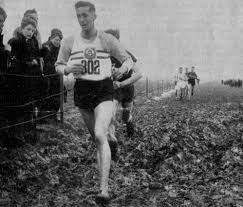
Soon after completing his national service, and continuing to push himself ever harder in training, he started to see tangible reward for his efforts; running in the AAA 6 mile championship at White City in July 1951 he raced to victory in a new British record time of 29’32”. Still aged just 20, he was awarded his first international vest to compete against France shortly after. A subsequent call up for an international tour saw him record 3 wins and a 2nd place in 4 long distance races over 8 days. Impressive stuff ! By now he was eyeing the possibility of running in the 1952 Olympic games. After breaking Sidney Wooderson’s British mile record, and reclaiming the 6 mile record from Walter Hesketh, he secured selection for both the 5000m and 10000m events in the Helsinki Olympics. Predictably, the media placed great expectations of gold medals upon him, but when the time came it was the staggering performances of Emil Zatopek for which these games will be forever remembered – winning the gold medal at 5000m, 10000m and the marathon was an unprecedented feat which has never been equalled.
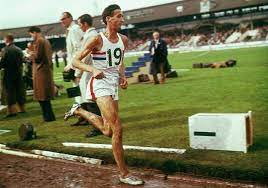
Pirie responded to this by further increasing his already heavy training load, and during the winter, won both the Southern and National cross country championships comfortably in early 1953. Consolidating these performances in the summer by setting his first world record at 10000m in July, knocking 11 seconds off the previous mark. In one remarkable 12 day period, he set new British records for 2 miles, 3 miles, 5000m and 10000m. At international level though he remained somewhat in the shadow of Zatopek and the Russian Vladimir Kuts. After resolutely “self-coaching” up to this point, in late 1953 Pirie sought the assistance of German coach Woldemar Gerschler, who was employing scientific techniques far in advance of anything happening in Britain at the time. Exhausting sessions on a treadmill, whilst wired up to electrocardiographs, VO2 max measurements, monitoring recovery rates now became part of his training regime. This, combined with his natural capacity and appetite to train at high intensity and high mileage meant that he was now equipped to become the very best. By 1955 Pirie had started to score victories over Zatopek, but as the 1956 Olympics approached, despite having set new world records at 10000m and 3000m, Vladimir Kuts was still regarded as the man to beat. On the day of the 10000m race, Pirie simply could not find the strength and speed to go with the lead and ended up a disappointed 8th place. Recovering sufficiently to get through the heats to the 5000m final a few days later, he redeemed himself with a silver medal. But as a supremely self confident athlete, this was less than he had expected. Kuts won both races.
By the late 1950s, Pirie travelled increasingly to race around the world – still achieving the very highest level of performance, but he was married by this time, and was beginning to look ahead to the time when his international career was over. Before that though, lay the prospect of his third Olympics, to be held in Rome in 1960. Going into the games he was in great shape and as confident as ever, but failed to qualify for the 5000m final, and could only finish 10th in the 10000m. Although he placed some blame on British athletics officialdom for not supporting athletes to travel early enough to acclimatise to the intense heat of the Roman summer, many observers remained of the view that he simply over trained, and didn’t allow himself any taper down prior to big races. This probably marked the end of his time at the very top of the sport, but he continued globe trotting to find high quality races, and he ran (and won) his last race in a British vest in September 1961. To see a piece of vintage footage from 1955, follow this link: https://youtu.be/vasFoqeWojM
Gordon Pirie went on to become the British champion in orienteering in 1967 and 1968, coached many athletes and lived a somewhat itinerant lifestyle at times. He wrote books and articles on training, and also made attacks on the press and the athletic officialdom of the day – his opinions and attitudes probably heralding the seismic changes at the top of the sport from a phoney amateurism presided over by out of touch officials, into the world class sport we’ve seen since the 1970s. He achieved 4 world records, and is listed in the Guinness book of records as having logged a staggering 216,000 miles of running in a 40 year period – the absolute total was doubtless somewhat higher. I haven’t scratched the surface of Gordon Pirie as a person – to get that, I’d recommend you read “The Impossible Hero”, by Dick Booth. He died in 1991, aged 60.
Check the blog regularly – 80+ posts and counting. Or quick search to see different subjects on the Index page. Hit the subscribe button below – it costs nothing, to receive the next post “on the subject of…..”


Very good read
LikeLike
Hi Kim Thanks for the Gordon Pirie legend piece and sorry I have only just caught up with it. Dennis Morden
Sent from Outlook for Androidhttps://aka.ms/AAb9ysg ________________________________
LikeLike